
Welcome to the Forams subsite on Invertebrate Paleontology!
Please enter a genera name to retrieve more information.

Asterorotalia
Classification
Phylum:
Protista
Subphylum:
Sarcodina
Class:
Reticularea
Subclass:
Granuloreticulosia
Order:
Foraminiferida
Suborder:
Rotalina
Superfamily:
Rotaliacea
Family:
Rotaliidae
Subfamily:
Rotaliinae
Formal Genus Name and Reference:
Asterorotalia HOFKER, 1950, *932, p. 73, 76
Type Species:
Calcarina pulchella d'Orbigny in de la Sagra, 1839, *1611, p. 80, = Rotalia trispinosa Thalmann, 1933, *1895, p. 248, OD (M)
Images
(Click to enlarge in a new window)
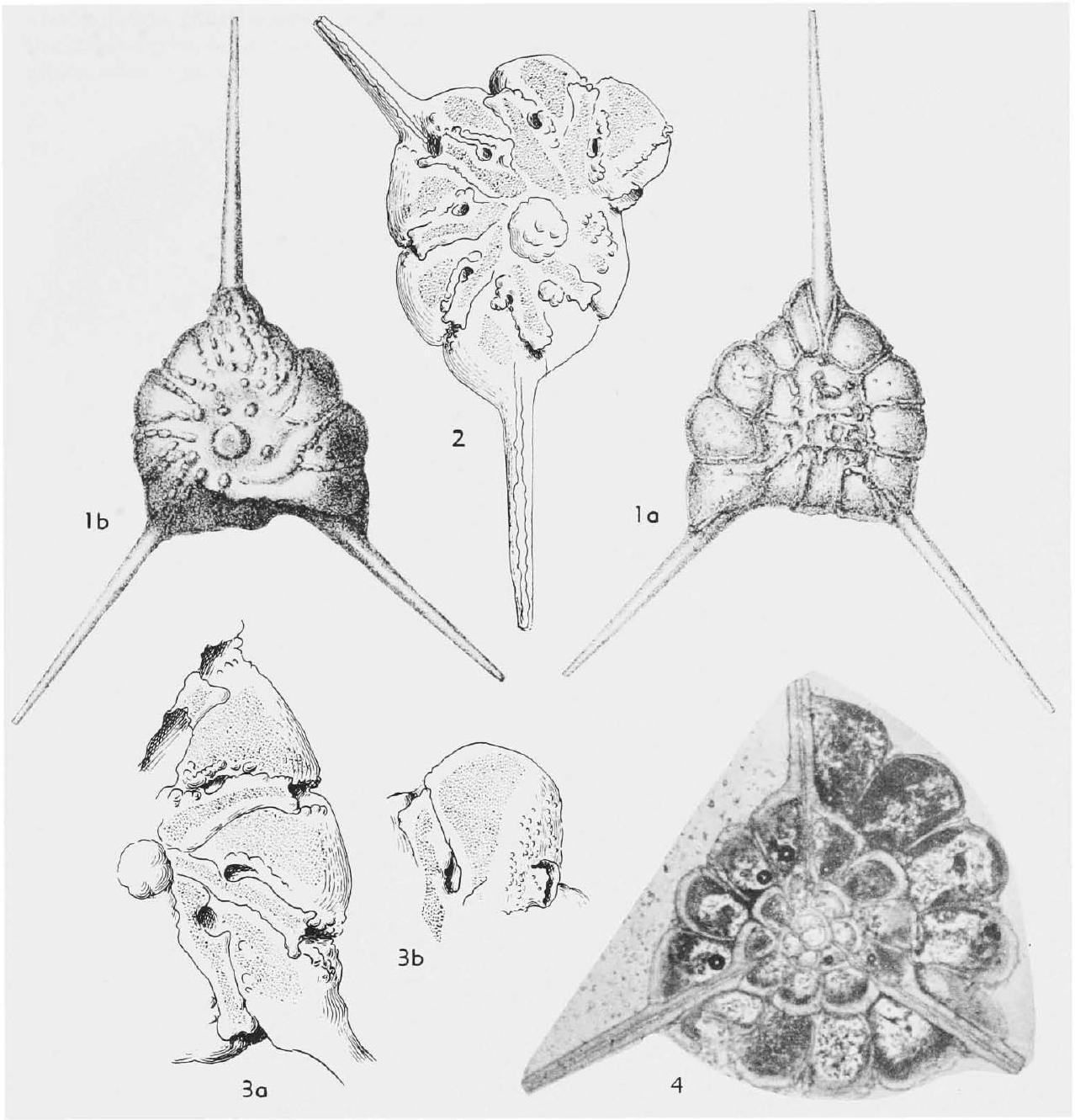 Fig. 482,1-4, *A. pulchella (D'ORBIGNY); Rec., Indon.; 1a,b, opposite sides, X50 (°200); 2, umbilical side of young specimen showing aperture, sutural plates, and their distal openings; 3a, portion of umbilical side of larger specimen; 3b, final chamber, show- ing poreless but tuberculate apertural face, and aperture; all X168 (*92Bc); 4, horiz. sec. show- ing spines with central canal, septal Raps, and intraseptal passages, X55 (*1534)
Synonyms
Geographic Distribution
Pleist.-Rec., Carib. (Cuba)-E.Indies(Indon.)-Pac.O.
Age Range
Beginning Stage in Treatise Usage:
Pleist.
Beginning International Stage:
Gelasian
Fraction Up In Beginning Stage:
0
Beginning Date:
2.58
Ending Stage in Treatise Usage:
Rec.
Ending International Stage:
Meghalayan
Fraction Up In Ending Stage:
100
Ending Date:
0
Description
Test free, trochospiral, biconvex, with 3 prominent slender spines radiating from test and continuous through all whorls from earliest, margin carinate, septa with intraseptal passages, opening as series of pores or fissures in and along sutures of umbilical side, partly covered by thin plates with distal openings, wall calcareous, perforate radial in structure, elongate spines formed by outer, main chamber lamellae, around stream of protoplasm emerging from intraseptal space, each spine containing tubular radial canal, surface of spiral side with irregular raised knobs and elevated sutures, interiomarginal aperture nearly equatorial in position, with strongly developed lips, which are fused in sutural region, posterior end of lip extended toward periphery, partly covering previous chamber and intraseptal fissure, leaving labial aperture in sutural position between lip and chamber, interior with strongly twisted tooth plate, intercameral foramina broadly elliptical in outline. [The type-species was originally described as Calcarina pulchella D'ORBIGNY, 1839, and transferred to Rotalia by BRADY (1884, °200, p. 710), an apparent synonym of Rotalia pulcllella D'ORBIGNY (1826, °1391, p. 274). It was later transferred to Pulvinulina (=Eponides) by JONES, PARKER & BRADY (1866, °1002, pI. 2, fig. 25-27), and Calcarilla pulchella was renamed Rotalia trispinosa by THALMAAN (1933, °1895, p. 248). However, as the 2 species were originally described in distinct genera and are not now regarded as congeneric, the specific name pulchella is valid for the present type-species.]
References
Museum or Author Information
Classification
Phylum:
Protista
Subphylum:
Sarcodina
Class:
Reticularea
Subclass:
Granuloreticulosia
Order:
Foraminiferida
Suborder:
Rotalina
Superfamily:
Rotaliacea
Family:
Rotaliidae
Subfamily:
Rotaliinae
Formal Genus Name and Reference:
Asterorotalia HOFKER, 1950, *932, p. 73, 76
Type Species:
Calcarina pulchella d'Orbigny in de la Sagra, 1839, *1611, p. 80, = Rotalia trispinosa Thalmann, 1933, *1895, p. 248, OD (M)
Images
(Click to enlarge in a new window)
Fig. 482,1-4, *A. pulchella (D'ORBIGNY); Rec., Indon.; 1a,b, opposite sides, X50 (°200); 2, umbilical side of young specimen showing aperture, sutural plates, and their distal openings; 3a, portion of umbilical side of larger specimen; 3b, final chamber, show- ing poreless but tuberculate apertural face, and aperture; all X168 (*92Bc); 4, horiz. sec. show- ing spines with central canal, septal Raps, and intraseptal passages, X55 (*1534)
Synonyms
Geographic Distribution
Pleist.-Rec., Carib. (Cuba)-E.Indies(Indon.)-Pac.O.
Age Range
Beginning Stage in Treatise Usage:
Pleist.
Beginning International Stage:
Gelasian
Fraction Up In Beginning Stage:
0
Beginning Date:
2.58
Ending Stage in Treatise Usage:
Rec.
Ending International Stage:
Meghalayan
Fraction Up In Ending Stage:
100
Ending Date:
0
Description
Test free, trochospiral, biconvex, with 3 prominent slender spines radiating from test and continuous through all whorls from earliest, margin carinate, septa with intraseptal passages, opening as series of pores or fissures in and along sutures of umbilical side, partly covered by thin plates with distal openings, wall calcareous, perforate radial in structure, elongate spines formed by outer, main chamber lamellae, around stream of protoplasm emerging from intraseptal space, each spine containing tubular radial canal, surface of spiral side with irregular raised knobs and elevated sutures, interiomarginal aperture nearly equatorial in position, with strongly developed lips, which are fused in sutural region, posterior end of lip extended toward periphery, partly covering previous chamber and intraseptal fissure, leaving labial aperture in sutural position between lip and chamber, interior with strongly twisted tooth plate, intercameral foramina broadly elliptical in outline. [The type-species was originally described as Calcarina pulchella D'ORBIGNY, 1839, and transferred to Rotalia by BRADY (1884, °200, p. 710), an apparent synonym of Rotalia pulcllella D'ORBIGNY (1826, °1391, p. 274). It was later transferred to Pulvinulina (=Eponides) by JONES, PARKER & BRADY (1866, °1002, pI. 2, fig. 25-27), and Calcarilla pulchella was renamed Rotalia trispinosa by THALMAAN (1933, °1895, p. 248). However, as the 2 species were originally described in distinct genera and are not now regarded as congeneric, the specific name pulchella is valid for the present type-species.]