
Welcome to the Forams subsite on Invertebrate Paleontology!
Please enter a genera name to retrieve more information.

Dicyclina
Classification
Phylum:
Protista
Subphylum:
Sarcodina
Class:
Reticularea
Subclass:
Granuloreticulosia
Order:
Foraminiferida
Suborder:
Textulariina
Superfamily:
Lituolacea
Family:
Dicyclinidae
Subfamily:
Dicyclininae
Formal Genus Name and Reference:
Dicyclina MUNIER-CHALMAS, 1887, *1325, p. xxx
Type Species:
D. schlumbergeri, OD
Images
(Click to enlarge in a new window)
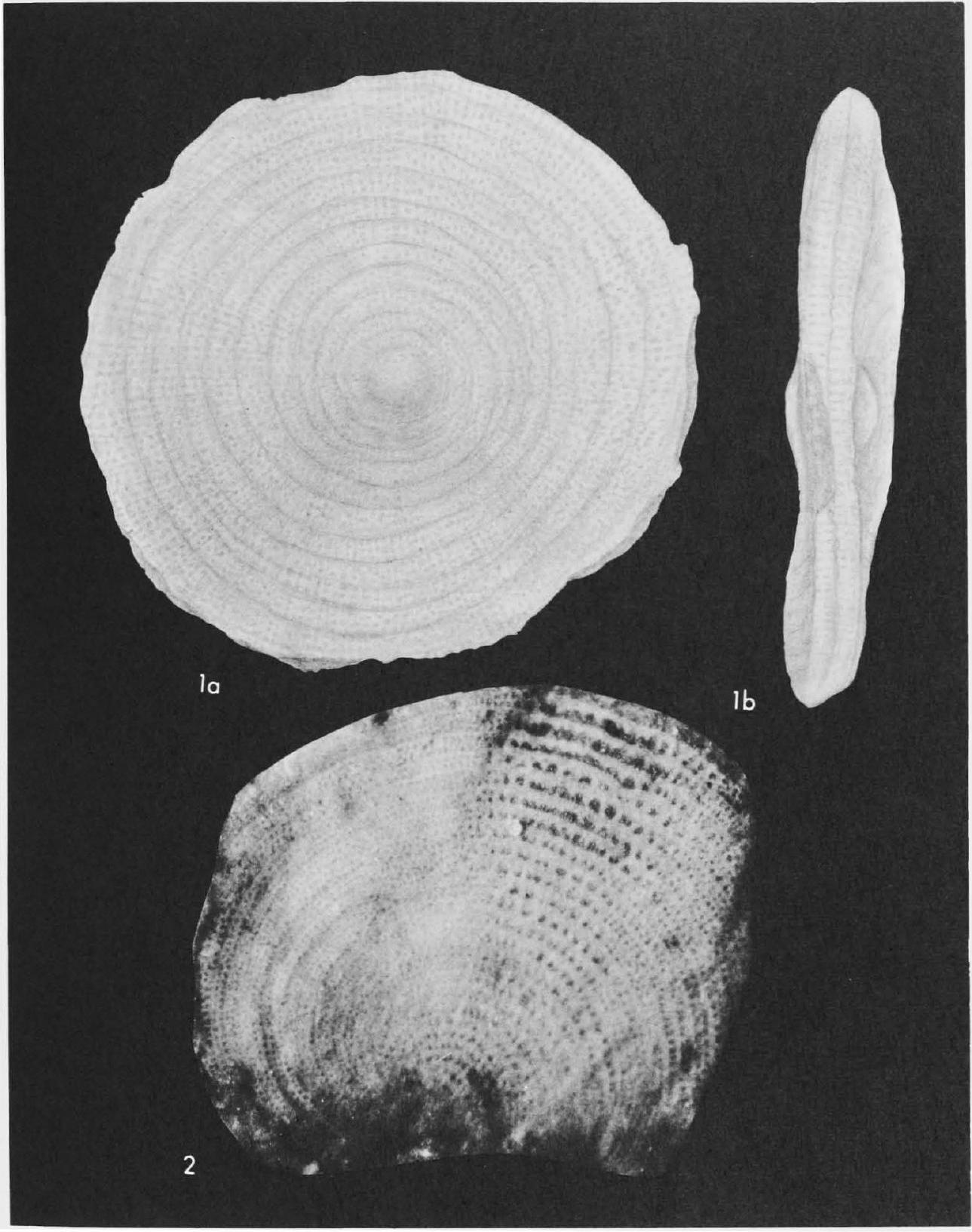 Fig. 209,1. *D. schlumbergeri, IIe Madame; 1a,b, side, edge views of lectotype (here designated, Sorbonne ColI., Paris), X33 (*2117). --Fig. 210,1. Internal structure of Dicyclina and Cllneolina (diagram.); la, transv. sec. along radius; 1b-g, secs. parallel to plane of development cut progressively from surface (1 b) to median layer (1 g); 1h-j, transv. secs. perpend. to radius (*901).
Synonyms
Geographic Distribution
Eu.
Age Range
Beginning Stage in Treatise Usage:
U.Cret.(Cenoman.)
Beginning International Stage:
Cenomanian
Fraction Up In Beginning Stage:
0
Beginning Date:
100.5
Ending Stage in Treatise Usage:
U.Cret.(Cenoman.)
Ending International Stage:
Cenomanian
Fraction Up In Ending Stage:
100
Ending Date:
93.9
Description
Test free, flattened, discoidal, early planispiral chambers in 2 parallel layers forming raised central knob, remainder consisting of 2 layers of annular chambers which are subdivided by radial partitions into chamberlets, wall agglutinated, of calcareous fragments with imperforate epidermis, walls of the primary chambers recurved in section toward center of test, not meeting peripheral wall of preceding chamber or that of opposite layer, leaving median zone between incurved ends of opposing primary chambers, interior subdivided by numerous, thin radial partitions perpendicular to median layer and in alignment from one primary chamber to next, dividing primary chamber into rectangular chamberlets which may be resubdivided by 3 or 4 partial partitions in each chamberlet, those of same cycle communicating by means of large pore through each radial partition; aperture comprising single median row of openings in slight depression at peripheral margin. [The types of D. schlumbergeri, from the Cenomanian of lIe Madame, France, are in the Sorbonne Collections, Paris. Four specimens on the original slide have about the same size as that refigured here, and 2 fragments would have been approximately twice as large.]
References
Museum or Author Information
Classification
Phylum:
Protista
Subphylum:
Sarcodina
Class:
Reticularea
Subclass:
Granuloreticulosia
Order:
Foraminiferida
Suborder:
Textulariina
Superfamily:
Lituolacea
Family:
Dicyclinidae
Subfamily:
Dicyclininae
Formal Genus Name and Reference:
Dicyclina MUNIER-CHALMAS, 1887, *1325, p. xxx
Type Species:
D. schlumbergeri, OD
Images
(Click to enlarge in a new window)
Fig. 209,1. *D. schlumbergeri, IIe Madame; 1a,b, side, edge views of lectotype (here designated, Sorbonne ColI., Paris), X33 (*2117). --Fig. 210,1. Internal structure of Dicyclina and Cllneolina (diagram.); la, transv. sec. along radius; 1b-g, secs. parallel to plane of development cut progressively from surface (1 b) to median layer (1 g); 1h-j, transv. secs. perpend. to radius (*901).
Synonyms
Geographic Distribution
Eu.
Age Range
Beginning Stage in Treatise Usage:
U.Cret.(Cenoman.)
Beginning International Stage:
Cenomanian
Fraction Up In Beginning Stage:
0
Beginning Date:
100.5
Ending Stage in Treatise Usage:
U.Cret.(Cenoman.)
Ending International Stage:
Cenomanian
Fraction Up In Ending Stage:
100
Ending Date:
93.9
Description
Test free, flattened, discoidal, early planispiral chambers in 2 parallel layers forming raised central knob, remainder consisting of 2 layers of annular chambers which are subdivided by radial partitions into chamberlets, wall agglutinated, of calcareous fragments with imperforate epidermis, walls of the primary chambers recurved in section toward center of test, not meeting peripheral wall of preceding chamber or that of opposite layer, leaving median zone between incurved ends of opposing primary chambers, interior subdivided by numerous, thin radial partitions perpendicular to median layer and in alignment from one primary chamber to next, dividing primary chamber into rectangular chamberlets which may be resubdivided by 3 or 4 partial partitions in each chamberlet, those of same cycle communicating by means of large pore through each radial partition; aperture comprising single median row of openings in slight depression at peripheral margin. [The types of D. schlumbergeri, from the Cenomanian of lIe Madame, France, are in the Sorbonne Collections, Paris. Four specimens on the original slide have about the same size as that refigured here, and 2 fragments would have been approximately twice as large.]