
Welcome to the Forams subsite on Invertebrate Paleontology!
Please enter a genera name to retrieve more information.

Hedbergella
Classification
Phylum:
Protista
Subphylum:
Sarcodina
Class:
Reticularea
Subclass:
Granuloreticulosia
Order:
Foraminiferida
Suborder:
Rotalina
Superfamily:
Globigerinacea
Family:
Rotaliporidae
Subfamily:
Hedbergellinae
Formal Genus Name and Reference:
Hedbergella Brönnimann & BROWN, 1958, *236, p. 16
Type Species:
Anomalina lorneiana d'Orbigny var. trocoidea GANDOLFI, 1942, *768, p. 98, OD
Images
(Click to enlarge in a new window)
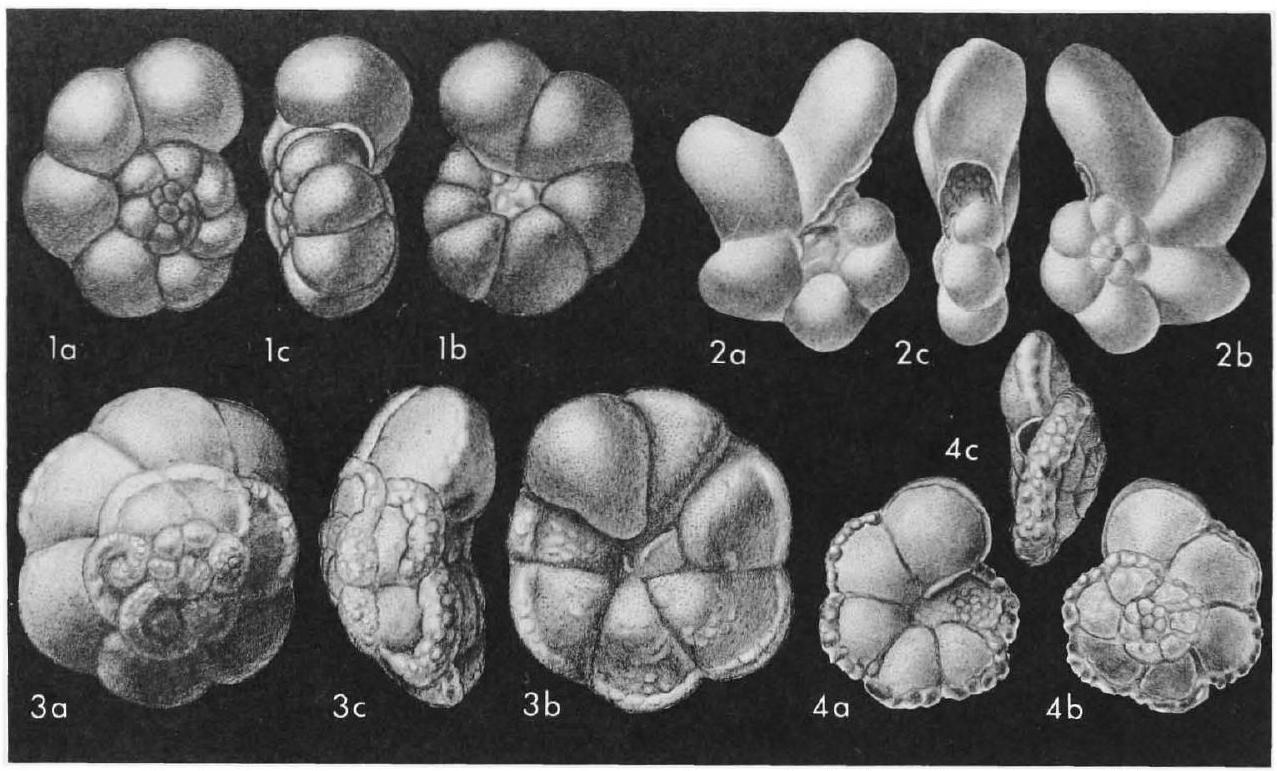 Fig. 527, 1. *H. trocoidea (Gandolfi), U.Cret. (Cenoman. ), Blake Plateau, Atl.O., 1a-c, spiral, umbilical, and edge views, X75 (*2117)
Synonyms
Praeglobotruncana
Geographic Distribution
cosmop.
Age Range
Beginning Stage in Treatise Usage:
L.Cret.(Hauteriv.)
Beginning International Stage:
Hauterivian
Fraction Up In Beginning Stage:
0
Beginning Date:
132.6
Ending Stage in Treatise Usage:
U.Cret.(Maastricht.)
Ending International Stage:
Maastrichtian
Fraction Up In Ending Stage:
100
Ending Date:
66.04
Description
Test free, trochospiral, biconvex, umbilicate, periphery rounded, with no indication of keel or poreless margin, chambers globular to ovate, sutures depressed, radial, straight to curved, wall calcareous, finely perforate, radial in structure, surface smooth to hispid or rugose, aperture an interiomarginal, extraumbilical-umbilical arch commonly bordered above by narrow lip or spatulate flap, and in forms with broad, open umbilicus, successive apertural flaps may remain visible to show serrate or scalloped border around umbilicus. [Hedbergella includes species which are otherwise similar to Praeglobotrttncana but lacking a keel or poreless margin. The rounded chambers are reminiscent of Globigerina but the aperture is extraumbilical, rather than umbilical, and the umbilicus is commonly narrow.J
References
Museum or Author Information
Classification
Phylum:
Protista
Subphylum:
Sarcodina
Class:
Reticularea
Subclass:
Granuloreticulosia
Order:
Foraminiferida
Suborder:
Rotalina
Superfamily:
Globigerinacea
Family:
Rotaliporidae
Subfamily:
Hedbergellinae
Formal Genus Name and Reference:
Hedbergella Brönnimann & BROWN, 1958, *236, p. 16
Type Species:
Anomalina lorneiana d'Orbigny var. trocoidea GANDOLFI, 1942, *768, p. 98, OD
Images
(Click to enlarge in a new window)
Fig. 527, 1. *H. trocoidea (Gandolfi), U.Cret. (Cenoman. ), Blake Plateau, Atl.O., 1a-c, spiral, umbilical, and edge views, X75 (*2117)
Synonyms
Praeglobotruncana
Geographic Distribution
cosmop.
Age Range
Beginning Stage in Treatise Usage:
L.Cret.(Hauteriv.)
Beginning International Stage:
Hauterivian
Fraction Up In Beginning Stage:
0
Beginning Date:
132.6
Ending Stage in Treatise Usage:
U.Cret.(Maastricht.)
Ending International Stage:
Maastrichtian
Fraction Up In Ending Stage:
100
Ending Date:
66.04
Description
Test free, trochospiral, biconvex, umbilicate, periphery rounded, with no indication of keel or poreless margin, chambers globular to ovate, sutures depressed, radial, straight to curved, wall calcareous, finely perforate, radial in structure, surface smooth to hispid or rugose, aperture an interiomarginal, extraumbilical-umbilical arch commonly bordered above by narrow lip or spatulate flap, and in forms with broad, open umbilicus, successive apertural flaps may remain visible to show serrate or scalloped border around umbilicus. [Hedbergella includes species which are otherwise similar to Praeglobotrttncana but lacking a keel or poreless margin. The rounded chambers are reminiscent of Globigerina but the aperture is extraumbilical, rather than umbilical, and the umbilicus is commonly narrow.J