
Welcome to the Forams subsite on Invertebrate Paleontology!
Please enter a genera name to retrieve more information.

Hoeglundina
Classification
Phylum:
Protista
Subphylum:
Sarcodina
Class:
Reticularea
Subclass:
Granuloreticulosia
Order:
Foraminiferida
Suborder:
Rotalina
Superfamily:
Robertinacea
Family:
Ceratobuliminidae
Subfamily:
Epistomininae
Formal Genus Name and Reference:
Hoeglundina BROTZEN, 1948, *241, p. 92
Type Species:
Rotalia elegans D'ORBIGNY, 1826, *1391, p. 272, OD
Images
(Click to enlarge in a new window)
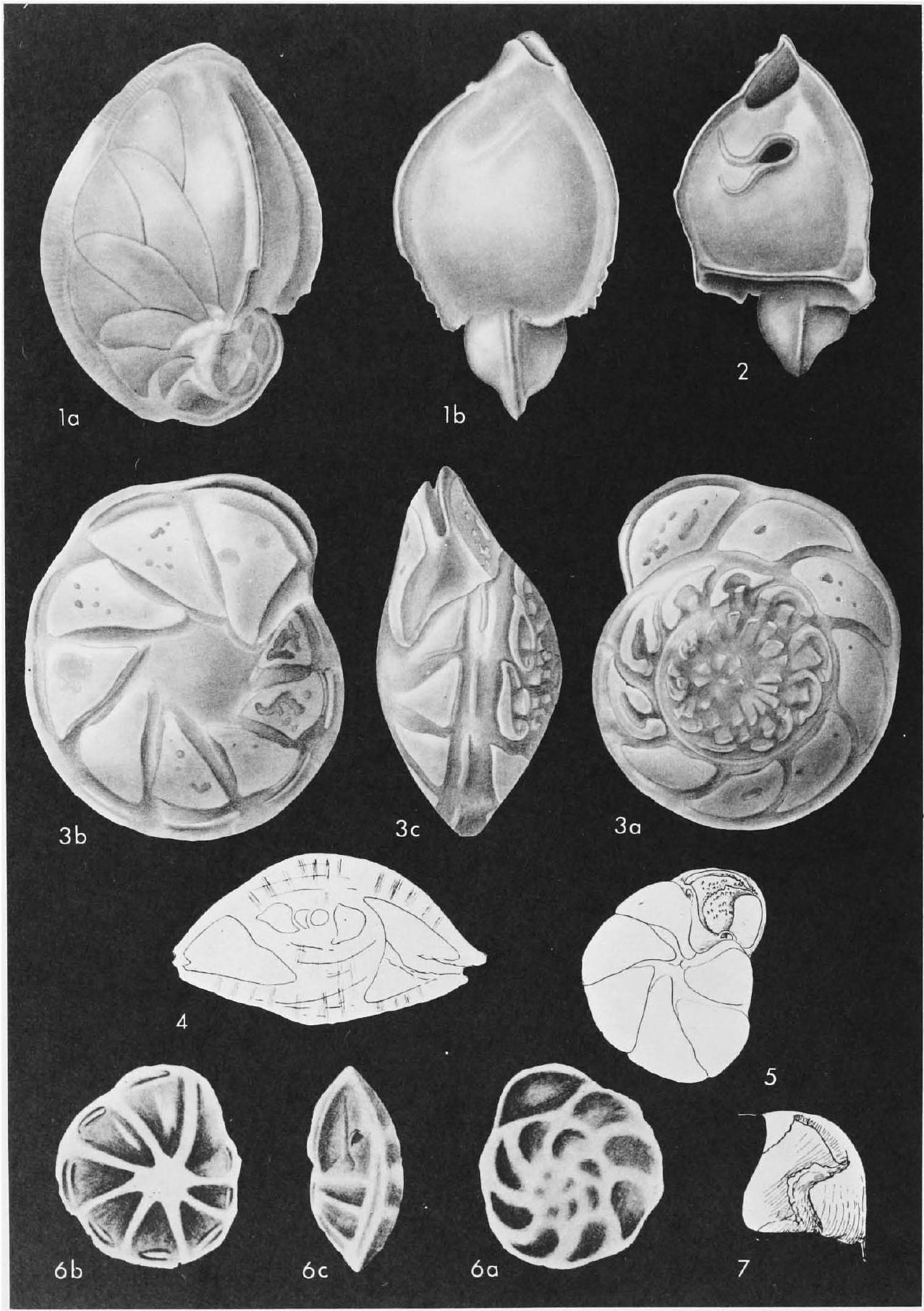 Fig. 636,3-5. *H. elegans (d'Orbigny), Rec., Carib.; 3a-c, opp. sides and edge view, X31 (*2117); 4, axial sec. showing internal partition in final chamber only, X20 (°943); 5, umbilical view of small specimen with final chamber clarified to show internal partition and position of areal and lateromarginal apertures, enlarged (*928c). -- Fig. 636,6,7. H. chapmani (TEN DAM), L.Cret., Eu.(Neth.); 6a-c, opp. sides and edge view of holotype, X57 (°555); 7, last chamber clarified to show internal partition, X80 (*943)
Synonyms
Geographic Distribution
cosmop.
Age Range
Beginning Stage in Treatise Usage:
M.Jur.(Dogger)
Beginning International Stage:
Aalenian
Fraction Up In Beginning Stage:
0
Beginning Date:
174.7
Ending Stage in Treatise Usage:
Rec.
Ending International Stage:
Meghalayan
Fraction Up In Ending Stage:
100
Ending Date:
0
Description
Test similar to Epistomina with more highly developed internal partition extending from posterior wall of chambers and always secondarily resorbed from earlier chambers, lateromarginal aperture nearly peripheral in position extending breadth of chambers, those of earlier chambers may remain open or be secondarily closed. [Hiltermannia was separated on the basis of a smaller internal partition. relative size being a feature here regarded as of only specific importance.]
References
Museum or Author Information
Classification
Phylum:
Protista
Subphylum:
Sarcodina
Class:
Reticularea
Subclass:
Granuloreticulosia
Order:
Foraminiferida
Suborder:
Rotalina
Superfamily:
Robertinacea
Family:
Ceratobuliminidae
Subfamily:
Epistomininae
Formal Genus Name and Reference:
Hoeglundina BROTZEN, 1948, *241, p. 92
Type Species:
Rotalia elegans D'ORBIGNY, 1826, *1391, p. 272, OD
Images
(Click to enlarge in a new window)
Fig. 636,3-5. *H. elegans (d'Orbigny), Rec., Carib.; 3a-c, opp. sides and edge view, X31 (*2117); 4, axial sec. showing internal partition in final chamber only, X20 (°943); 5, umbilical view of small specimen with final chamber clarified to show internal partition and position of areal and lateromarginal apertures, enlarged (*928c). -- Fig. 636,6,7. H. chapmani (TEN DAM), L.Cret., Eu.(Neth.); 6a-c, opp. sides and edge view of holotype, X57 (°555); 7, last chamber clarified to show internal partition, X80 (*943)
Synonyms
Geographic Distribution
cosmop.
Age Range
Beginning Stage in Treatise Usage:
M.Jur.(Dogger)
Beginning International Stage:
Aalenian
Fraction Up In Beginning Stage:
0
Beginning Date:
174.7
Ending Stage in Treatise Usage:
Rec.
Ending International Stage:
Meghalayan
Fraction Up In Ending Stage:
100
Ending Date:
0
Description
Test similar to Epistomina with more highly developed internal partition extending from posterior wall of chambers and always secondarily resorbed from earlier chambers, lateromarginal aperture nearly peripheral in position extending breadth of chambers, those of earlier chambers may remain open or be secondarily closed. [Hiltermannia was separated on the basis of a smaller internal partition. relative size being a feature here regarded as of only specific importance.]