
Welcome to the Forams subsite on Invertebrate Paleontology!
Please enter a genera name to retrieve more information.
Kahlerina
Classification
Phylum:
Protista
Subphylum:
Sarcodina
Class:
Reticularea
Subclass:
Granuloreticulosia
Order:
Foraminiferida
Suborder:
Fusulinina
Superfamily:
Endothyracea
Family:
Endothyridae
Subfamily:
Endothyrinae
Formal Genus Name and Reference:
Kahlerina Kochansky-Devidé & RAMOVS, 1955, *1047A, p. 383, 412
Type Species:
K. pachytheca, OD
Images
(Click to enlarge in a new window)
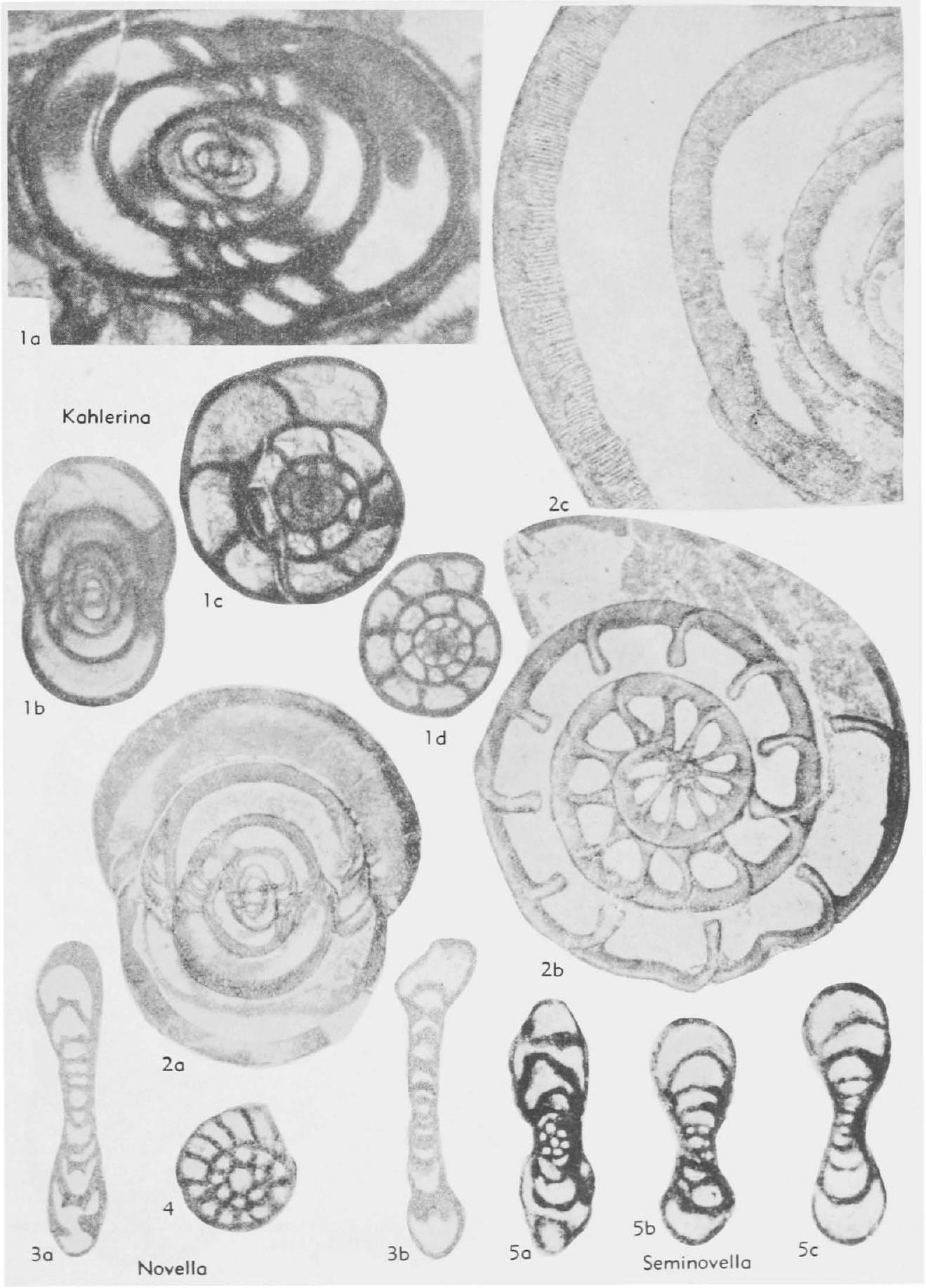
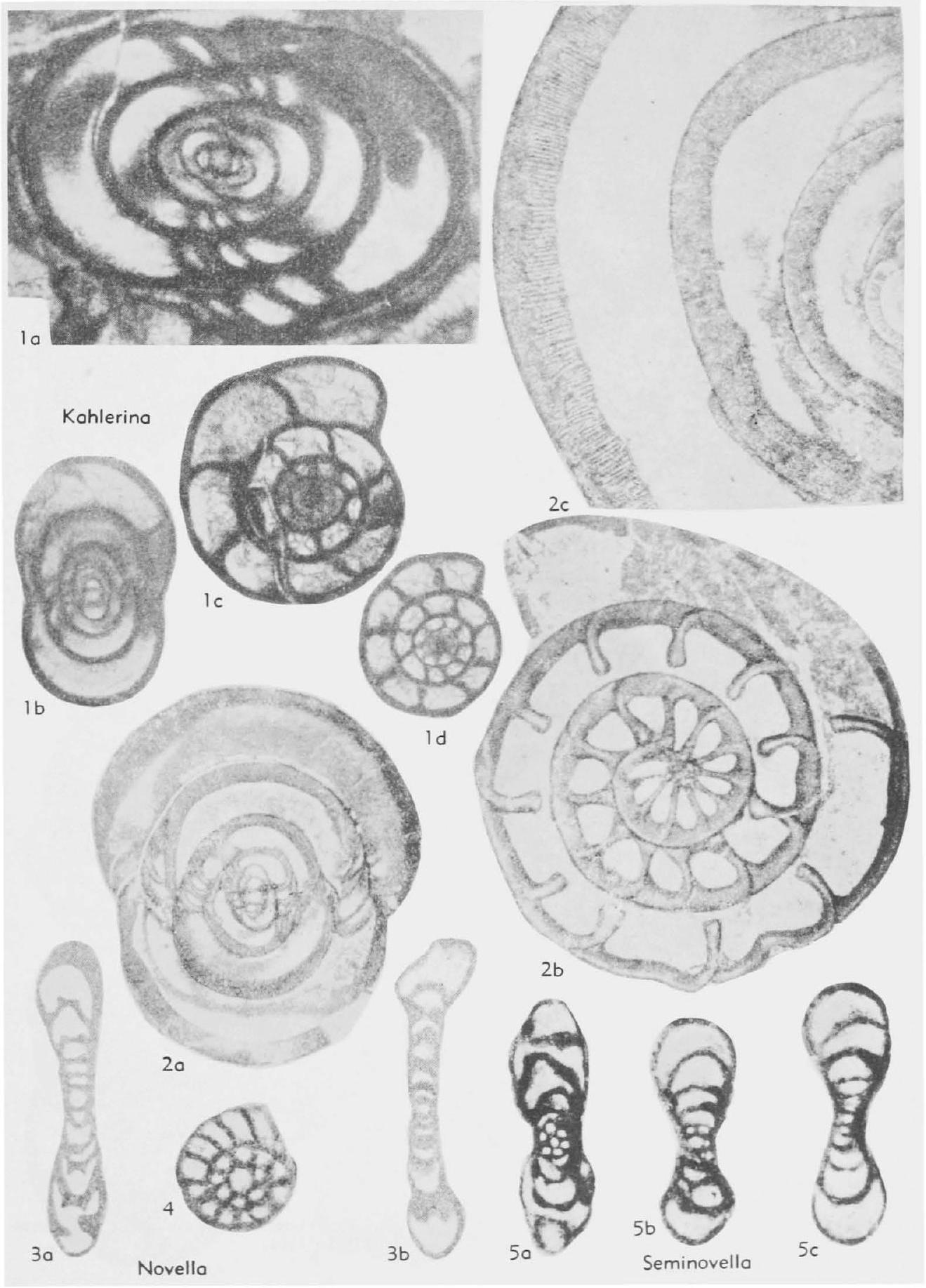 Fig. 262A,1. *K. pachytheea, U.Perm., Yugoslav.; 1a, axial sec. of microspheric form (holotype), X40; 1b, axial sec. of megalospheric form, X20; 1c,d, median secs. of microspheric forms, X20 (*1047A). --Fig. 262A,2. K. ussurica (SOSNINA), U.Perm., USSR; 2a.b, axial and median secs., X25; 2c, portion of wall showing "keriothecal" structure, X70 (*1040).
Synonyms
Ussuriella
Geographic Distribution
Yugoslav.-USSR.
Age Range
Beginning Stage in Treatise Usage:
U.Perm.
Beginning International Stage:
Wuchiapingian
Fraction Up In Beginning Stage:
0
Beginning Date:
259.55
Ending Stage in Treatise Usage:
U.Perm.
Ending International Stage:
Changhsingian
Fraction Up In Ending Stage:
100
Ending Date:
251.9
Description
Test enrolled, subspherical, umbilici slightly indented, early coiling somewhat plectogyral, that of microspheric form having 1 or 2 abrupt turns of about 90 degrees similar to Endothyra, microspheric proloculus small and globular, megalospheric proloculus up to 0.14 mm, 8-10 chambers per whorl, increasing fairly rapidly in height, septa straight radial, thick-walled; wall thick, of 2 layers (referred to tectum and keriotheca, although keriothecal structure is indistinct), reduced chomata, as in Quasiendotlzyra. and some very small parachomata rarely present, tunnel low, not continuous, observed rarely; foramina and very fine septal pores present. [Originally Kahlerina was regarded as a primitive form placed in the Verbeekininae *1047A), but later it was transferred to the Staffellinae (*1509). It is here considered as simpler than the Fusulinacea and tentatively placed in the Endothyrinae.]
References
Museum or Author Information
Classification
Phylum:
Protista
Subphylum:
Sarcodina
Class:
Reticularea
Subclass:
Granuloreticulosia
Order:
Foraminiferida
Suborder:
Fusulinina
Superfamily:
Endothyracea
Family:
Endothyridae
Subfamily:
Endothyrinae
Formal Genus Name and Reference:
Kahlerina Kochansky-Devidé & RAMOVS, 1955, *1047A, p. 383, 412
Type Species:
K. pachytheca, OD
Images
(Click to enlarge in a new window)
Fig. 262A,1. *K. pachytheea, U.Perm., Yugoslav.; 1a, axial sec. of microspheric form (holotype), X40; 1b, axial sec. of megalospheric form, X20; 1c,d, median secs. of microspheric forms, X20 (*1047A). --Fig. 262A,2. K. ussurica (SOSNINA), U.Perm., USSR; 2a.b, axial and median secs., X25; 2c, portion of wall showing "keriothecal" structure, X70 (*1040).
Synonyms
Ussuriella
Geographic Distribution
Yugoslav.-USSR.
Age Range
Beginning Stage in Treatise Usage:
U.Perm.
Beginning International Stage:
Wuchiapingian
Fraction Up In Beginning Stage:
0
Beginning Date:
259.55
Ending Stage in Treatise Usage:
U.Perm.
Ending International Stage:
Changhsingian
Fraction Up In Ending Stage:
100
Ending Date:
251.9
Description
Test enrolled, subspherical, umbilici slightly indented, early coiling somewhat plectogyral, that of microspheric form having 1 or 2 abrupt turns of about 90 degrees similar to Endothyra, microspheric proloculus small and globular, megalospheric proloculus up to 0.14 mm, 8-10 chambers per whorl, increasing fairly rapidly in height, septa straight radial, thick-walled; wall thick, of 2 layers (referred to tectum and keriotheca, although keriothecal structure is indistinct), reduced chomata, as in Quasiendotlzyra. and some very small parachomata rarely present, tunnel low, not continuous, observed rarely; foramina and very fine septal pores present. [Originally Kahlerina was regarded as a primitive form placed in the Verbeekininae *1047A), but later it was transferred to the Staffellinae (*1509). It is here considered as simpler than the Fusulinacea and tentatively placed in the Endothyrinae.]