
Welcome to the Forams subsite on Invertebrate Paleontology!
Please enter a genera name to retrieve more information.

Orbulina
Classification
Phylum:
Protista
Subphylum:
Sarcodina
Class:
Reticularea
Subclass:
Granuloreticulosia
Order:
Foraminiferida
Suborder:
Rotalina
Superfamily:
Globigerinacea
Family:
Globigerinidae
Subfamily:
Orbulininae
Formal Genus Name and Reference:
Orbulina D'ORBIGNY in de la Sagra, 1839, *1611, p. 2
Type Species:
O. universa, OD (M)
Images
(Click to enlarge in a new window)
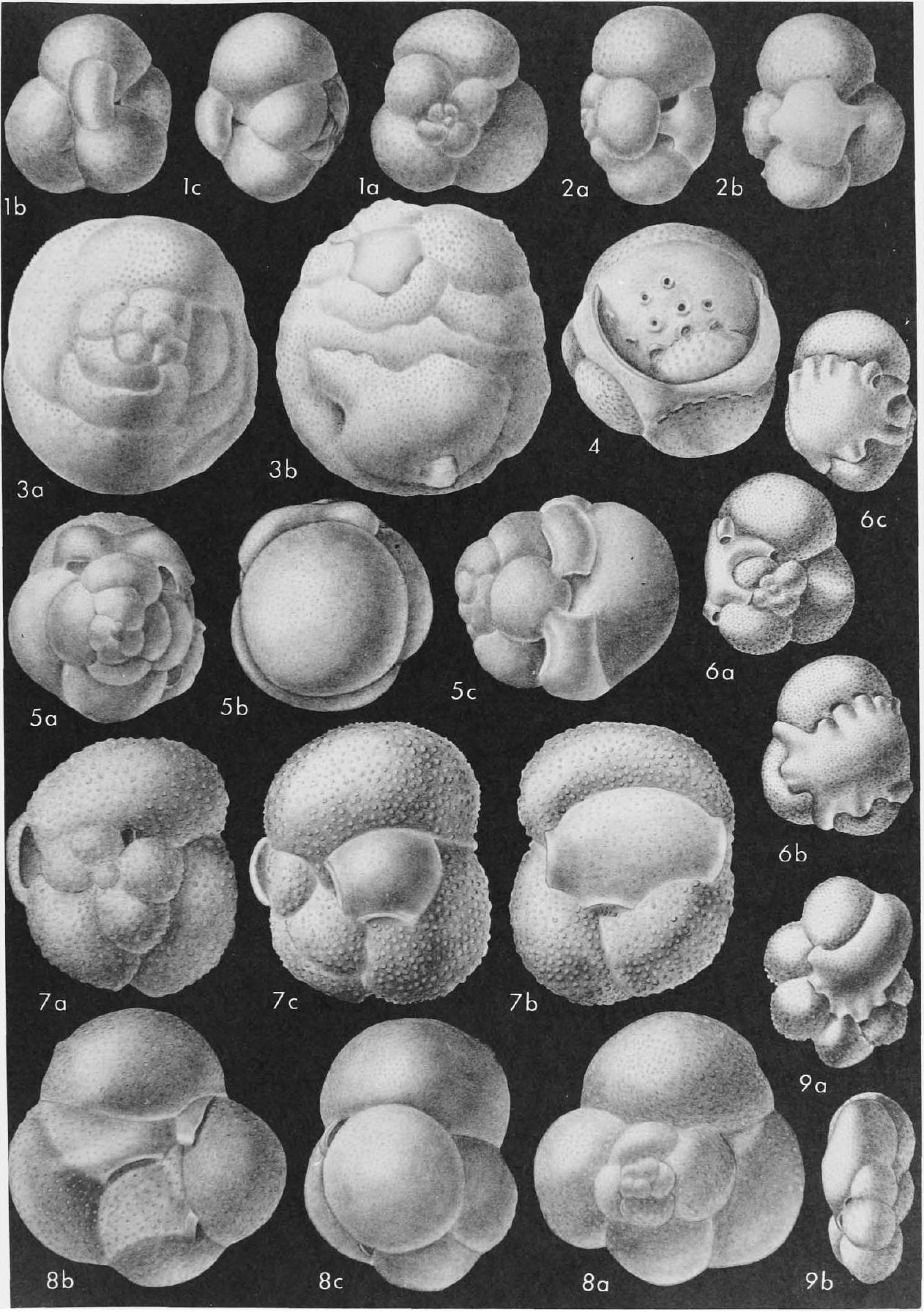 Fig. 541,4-7. *0. universa, Rec., Atl.O. (4-6), Mio., USA (Fla.) (7); 4, typical spherical microspheric specimen, with globigerine stage completely enclosed, X40; 5,6, 2- and 3- chambered (probably megalospheric forms), X40; 7, microspheric hypotype with globigerine stage visible at side of test, X70 (*164)
Synonyms
Coscinosphaera
Geographic Distribution
cosmop.
Age Range
Beginning Stage in Treatise Usage:
L.Mio.
Beginning International Stage:
Aquitanian
Fraction Up In Beginning Stage:
0
Beginning Date:
23.04
Ending Stage in Treatise Usage:
Rec.
Ending International Stage:
Meghalayan
Fraction Up In Ending Stage:
100
Ending Date:
0
Description
Test free, adult generally spherical and composed of a single chamber, rarely 2 or 3-chambered, early chambers trochospiral in microspheric form, in adult the globigerine coil may remain visible at one side or may be completely enveloped by final spherical chamber, or test may consist of number of completely enveloping, concentric globular chambers (probably megalospheric form), primary aperture interiomarginal, umbilical in early globigerine stage where this is present, areal in adult, with numerous small openings scattered over one side or over much of test, small sutural secondary openings commonly found around early globigerine chambers of specimens where these are visible at surface, in sexual reproduction gametes formed within spherical test, accompanied by gradual resorption of wall of early globigerine chambers and in Recent forms by descending vertical migration in water column from surface to depth of about 300 m., gametes then escaping through large perforations in wall, gametes biflagellate, with homogeneous nucleus, no axostyle, and with large oily inclusion (*1105), cytoplasm with abundant areolated ectoplasm surrounding test, pseudopodia elongate, radiating, numerous and rigid.
References
Museum or Author Information
Classification
Phylum:
Protista
Subphylum:
Sarcodina
Class:
Reticularea
Subclass:
Granuloreticulosia
Order:
Foraminiferida
Suborder:
Rotalina
Superfamily:
Globigerinacea
Family:
Globigerinidae
Subfamily:
Orbulininae
Formal Genus Name and Reference:
Orbulina D'ORBIGNY in de la Sagra, 1839, *1611, p. 2
Type Species:
O. universa, OD (M)
Images
(Click to enlarge in a new window)
Fig. 541,4-7. *0. universa, Rec., Atl.O. (4-6), Mio., USA (Fla.) (7); 4, typical spherical microspheric specimen, with globigerine stage completely enclosed, X40; 5,6, 2- and 3- chambered (probably megalospheric forms), X40; 7, microspheric hypotype with globigerine stage visible at side of test, X70 (*164)
Synonyms
Coscinosphaera
Geographic Distribution
cosmop.
Age Range
Beginning Stage in Treatise Usage:
L.Mio.
Beginning International Stage:
Aquitanian
Fraction Up In Beginning Stage:
0
Beginning Date:
23.04
Ending Stage in Treatise Usage:
Rec.
Ending International Stage:
Meghalayan
Fraction Up In Ending Stage:
100
Ending Date:
0
Description
Test free, adult generally spherical and composed of a single chamber, rarely 2 or 3-chambered, early chambers trochospiral in microspheric form, in adult the globigerine coil may remain visible at one side or may be completely enveloped by final spherical chamber, or test may consist of number of completely enveloping, concentric globular chambers (probably megalospheric form), primary aperture interiomarginal, umbilical in early globigerine stage where this is present, areal in adult, with numerous small openings scattered over one side or over much of test, small sutural secondary openings commonly found around early globigerine chambers of specimens where these are visible at surface, in sexual reproduction gametes formed within spherical test, accompanied by gradual resorption of wall of early globigerine chambers and in Recent forms by descending vertical migration in water column from surface to depth of about 300 m., gametes then escaping through large perforations in wall, gametes biflagellate, with homogeneous nucleus, no axostyle, and with large oily inclusion (*1105), cytoplasm with abundant areolated ectoplasm surrounding test, pseudopodia elongate, radiating, numerous and rigid.