
Welcome to the Forams subsite on Invertebrate Paleontology!
Please enter a genera name to retrieve more information.

Pararotalia
Classification
Phylum:
Protista
Subphylum:
Sarcodina
Class:
Reticularea
Subclass:
Granuloreticulosia
Order:
Foraminiferida
Suborder:
Rotalina
Superfamily:
Rotaliacea
Family:
Rotaliidae
Subfamily:
Rotaliinae
Formal Genus Name and Reference:
Pararotalia Y. Le CALVEZ, 1949, *1112, p. 32
Type Species:
Rotalia inermis TERQUEM, 1882, *, p. 68, OD
Images
(Click to enlarge in a new window)
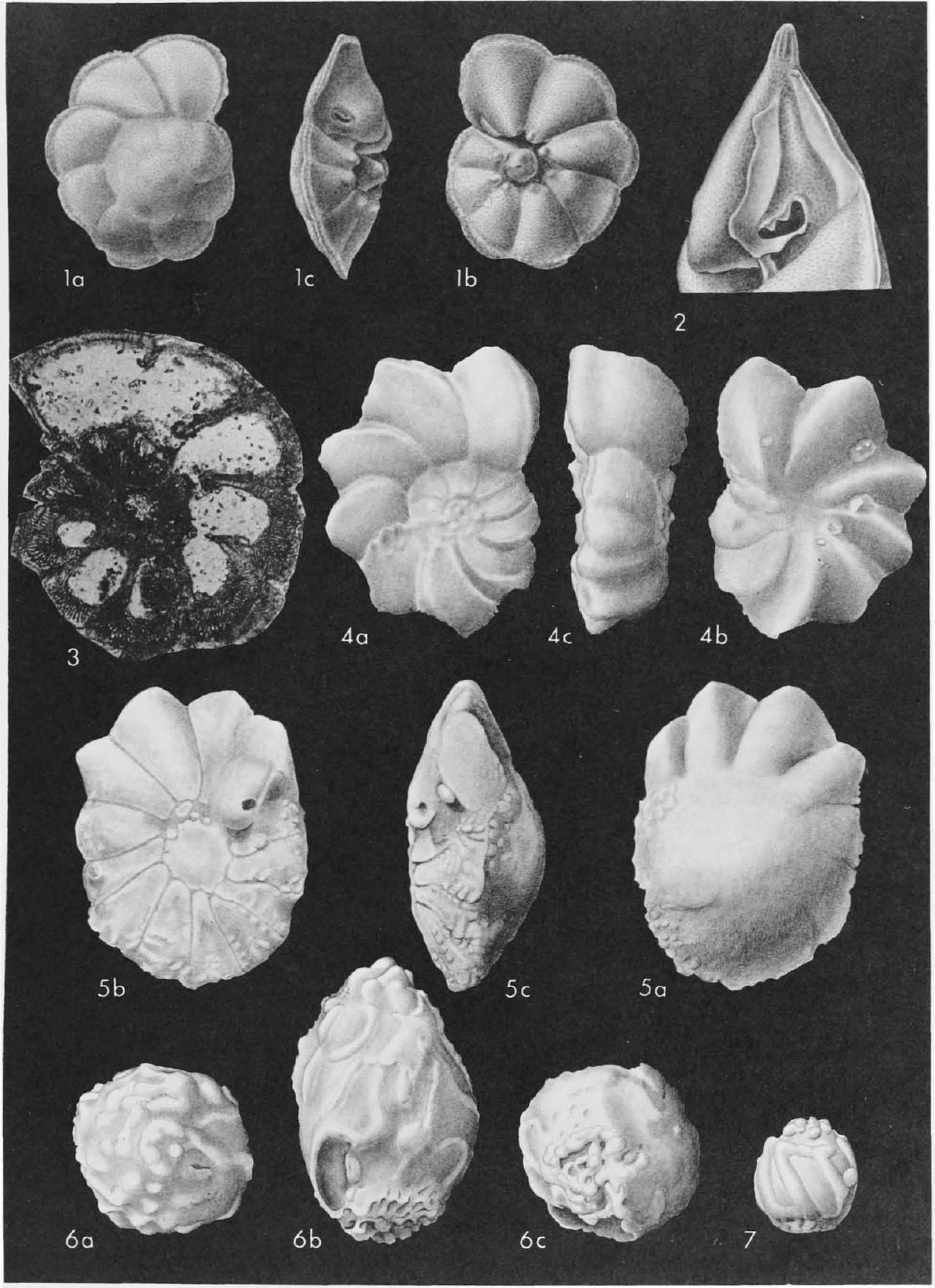 Fig. 486,1-3. *P. inermis (Terquem), M.Eoc.(Lutet.), Eu.(Fr.); 1a-c, opposite sides and edge view, X73, 2, apert. region of dissected specimen showing tooth plate of final chamber attached to intercameral foramen of penultimate chamber, X128 (*1171), 3, equat. sec. showing double septa and intra-septal passages, X65 (*1534). -- Fig. 486,4. P. nammalensis (HAQUE), Paleoc., Asia(Pak.); 4a-c, opposite sides and edge view of specimen origin- ally described as Woodella, X98 (*ZI17). -- Fig. 486,5. P. mexicana (NUTTALL), U.Eoc., Mex.; 5a-c, opposite sides and edge view of lectotype, here designated (*1370, pI. 50, fig. 7), XZ9 (°2117)
Synonyms
Geographic Distribution
U.Cret.(Coniac.)-Rec., cosmop.
Age Range
Beginning Stage in Treatise Usage:
U.Cret.(Coniac.)
Beginning International Stage:
Coniacian
Fraction Up In Beginning Stage:
0
Beginning Date:
89.39
Ending Stage in Treatise Usage:
Rec.
Ending International Stage:
Meghalayan
Fraction Up In Ending Stage:
100
Ending Date:
0
Description
Test free, trochospiral, plano-convex to biconvex, umbilicus filled by plug which may be broken out in preservation, chambers rounded to ovate in plan, may have smoothly rounded periphery or develop short, blunt peripheral spine on each chamber partially covered by umbilical flap: wall calcreous, perforate, radially built, rotaliid in structure, smooth or yariously ornamented with large solid spines or fine scattered spines or nodes; apertures on umbilical side, interiomarginal and extraumbilical-umbilical, with lip; internal "tooth plate" near umbilical and axial chamber wall, intercameral foramen narrow, elongate, commashaped or slitlike areal opening, consisting of portion of former aperture, roughly paralleling base of apertural face and restricted by tooth plate of following chamber. [Woodella is apparently synonymous with Pararotalia and the type-species W. granosa appears to be conspecific with Rotalia capdevilensis CUSHMAN & BERMUDEZ.]
References
Le Calvez, Yolande, 1949, Révision des Foraminitères Lutétiens du Bassin de Paris. II. Rotaliidae et familles affines: Carte Géol. Détaillée France, Mém., 54 p., 6 pl.——(1113) 1950, Révision des Foraminifères Lutétiens du Bassin de Paris, III. Polymorphinidae, Buliminidae, Nonionidae: Same, 64 p., 4 pl.(1114) 1952, Révision des Foraminifères Lutétiens du Bassin de Paris, IV. Valvulinidae, Peneroplidae, Ophthalmididae, Lagenidae: Same, p. 1-64, pl. 1-4.-(1115) 1959, Etude de quelques Foraminifères nouveaux du Cuisien Franco-Belge: Revue Micropaléont., v. 2, no. 1, p. 88-94, pl. 1.
Museum or Author Information
Classification
Phylum:
Protista
Subphylum:
Sarcodina
Class:
Reticularea
Subclass:
Granuloreticulosia
Order:
Foraminiferida
Suborder:
Rotalina
Superfamily:
Rotaliacea
Family:
Rotaliidae
Subfamily:
Rotaliinae
Formal Genus Name and Reference:
Pararotalia Y. Le CALVEZ, 1949, *1112, p. 32
Type Species:
Rotalia inermis TERQUEM, 1882, *, p. 68, OD
Images
(Click to enlarge in a new window)
Fig. 486,1-3. *P. inermis (Terquem), M.Eoc.(Lutet.), Eu.(Fr.); 1a-c, opposite sides and edge view, X73, 2, apert. region of dissected specimen showing tooth plate of final chamber attached to intercameral foramen of penultimate chamber, X128 (*1171), 3, equat. sec. showing double septa and intra-septal passages, X65 (*1534). -- Fig. 486,4. P. nammalensis (HAQUE), Paleoc., Asia(Pak.); 4a-c, opposite sides and edge view of specimen origin- ally described as Woodella, X98 (*ZI17). -- Fig. 486,5. P. mexicana (NUTTALL), U.Eoc., Mex.; 5a-c, opposite sides and edge view of lectotype, here designated (*1370, pI. 50, fig. 7), XZ9 (°2117)
Synonyms
Geographic Distribution
U.Cret.(Coniac.)-Rec., cosmop.
Age Range
Beginning Stage in Treatise Usage:
U.Cret.(Coniac.)
Beginning International Stage:
Coniacian
Fraction Up In Beginning Stage:
0
Beginning Date:
89.39
Ending Stage in Treatise Usage:
Rec.
Ending International Stage:
Meghalayan
Fraction Up In Ending Stage:
100
Ending Date:
0
Description
Test free, trochospiral, plano-convex to biconvex, umbilicus filled by plug which may be broken out in preservation, chambers rounded to ovate in plan, may have smoothly rounded periphery or develop short, blunt peripheral spine on each chamber partially covered by umbilical flap: wall calcreous, perforate, radially built, rotaliid in structure, smooth or yariously ornamented with large solid spines or fine scattered spines or nodes; apertures on umbilical side, interiomarginal and extraumbilical-umbilical, with lip; internal "tooth plate" near umbilical and axial chamber wall, intercameral foramen narrow, elongate, commashaped or slitlike areal opening, consisting of portion of former aperture, roughly paralleling base of apertural face and restricted by tooth plate of following chamber. [Woodella is apparently synonymous with Pararotalia and the type-species W. granosa appears to be conspecific with Rotalia capdevilensis CUSHMAN & BERMUDEZ.]
References
Le Calvez, Yolande, 1949, Révision des Foraminitères Lutétiens du Bassin de Paris. II. Rotaliidae et familles affines: Carte Géol. Détaillée France, Mém., 54 p., 6 pl.——(1113) 1950, Révision des Foraminifères Lutétiens du Bassin de Paris, III. Polymorphinidae, Buliminidae, Nonionidae: Same, 64 p., 4 pl.(1114) 1952, Révision des Foraminifères Lutétiens du Bassin de Paris, IV. Valvulinidae, Peneroplidae, Ophthalmididae, Lagenidae: Same, p. 1-64, pl. 1-4.-(1115) 1959, Etude de quelques Foraminifères nouveaux du Cuisien Franco-Belge: Revue Micropaléont., v. 2, no. 1, p. 88-94, pl. 1.