
Welcome to the Forams subsite on Invertebrate Paleontology!
Please enter a genera name to retrieve more information.

Praeglobotruncana
Classification
Phylum:
Protista
Subphylum:
Sarcodina
Class:
Reticularea
Subclass:
Granuloreticulosia
Order:
Foraminiferida
Suborder:
Rotalina
Superfamily:
Globigerinacea
Family:
Rotaliporidae
Subfamily:
Hedbergellinae
Formal Genus Name and Reference:
Praeglobotruncana BERMÚDEZ, 1952, *127, p. 52
Type Species:
Globorotalia delrioensis PLUMMER, 1931, *1463, p. 199, OD
Images
(Click to enlarge in a new window)
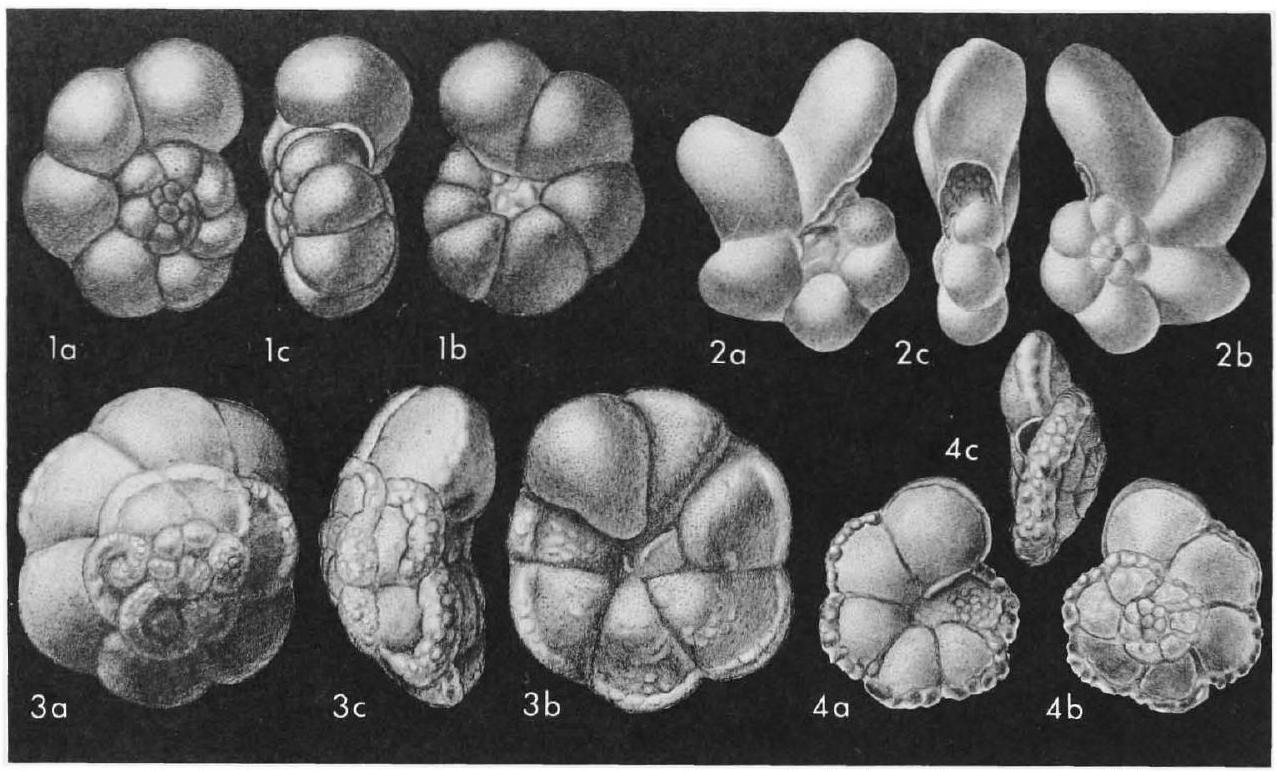 Fig. 527,3. P. stephani (Gandolfi), Cenoman., Switz., 3a-c, opposite sides and edge view, ×75 (*1183). -- Fig. 527,4. *P. delrioensis (Plummer), Cenoman., USA(Tex. ), 4a-c, umbilical, spiral, and edge views of topotype, ×75 (*1183)
Synonyms
Rotundina
Geographic Distribution
cosmop.
Age Range
Beginning Stage in Treatise Usage:
L. Cret.(U.Alb.)
Beginning International Stage:
Albian
Fraction Up In Beginning Stage:
50
Beginning Date:
106.85
Ending Stage in Treatise Usage:
U.Cret.(Cenoman.)
Ending International Stage:
Cenomanian
Fraction Up In Ending Stage:
100
Ending Date:
93.9
Description
Test free, trochospiral, biconvex to spiroconvex, umbilicate, periphery rounded to subangular, with more or less well-developed peripheral keel, chambers ovate to subangular, sutures on spiral side radial or curved, depressed to elevated, commonly thickened or beaded, on umbilical side depressed and radial, wall calcareous, finely perforate, radial in structure, surface smooth to hispid, aperture an interiomarginal, extraumbilical-umbilical arch, bordered by apertural lip. [Regarded as containing both carinate and noncarinate species by BOLLI, LOEBLlCH & TAPPAN (1957, *164), the genus is now restricted to include only species which have a peripheral keel or poreless margin. The noncarinate species are now placed in Hedbergella.]
References
Museum or Author Information
Classification
Phylum:
Protista
Subphylum:
Sarcodina
Class:
Reticularea
Subclass:
Granuloreticulosia
Order:
Foraminiferida
Suborder:
Rotalina
Superfamily:
Globigerinacea
Family:
Rotaliporidae
Subfamily:
Hedbergellinae
Formal Genus Name and Reference:
Praeglobotruncana BERMÚDEZ, 1952, *127, p. 52
Type Species:
Globorotalia delrioensis PLUMMER, 1931, *1463, p. 199, OD
Images
(Click to enlarge in a new window)
Fig. 527,3. P. stephani (Gandolfi), Cenoman., Switz., 3a-c, opposite sides and edge view, ×75 (*1183). -- Fig. 527,4. *P. delrioensis (Plummer), Cenoman., USA(Tex. ), 4a-c, umbilical, spiral, and edge views of topotype, ×75 (*1183)
Synonyms
Rotundina
Geographic Distribution
cosmop.
Age Range
Beginning Stage in Treatise Usage:
L. Cret.(U.Alb.)
Beginning International Stage:
Albian
Fraction Up In Beginning Stage:
50
Beginning Date:
106.85
Ending Stage in Treatise Usage:
U.Cret.(Cenoman.)
Ending International Stage:
Cenomanian
Fraction Up In Ending Stage:
100
Ending Date:
93.9
Description
Test free, trochospiral, biconvex to spiroconvex, umbilicate, periphery rounded to subangular, with more or less well-developed peripheral keel, chambers ovate to subangular, sutures on spiral side radial or curved, depressed to elevated, commonly thickened or beaded, on umbilical side depressed and radial, wall calcareous, finely perforate, radial in structure, surface smooth to hispid, aperture an interiomarginal, extraumbilical-umbilical arch, bordered by apertural lip. [Regarded as containing both carinate and noncarinate species by BOLLI, LOEBLlCH & TAPPAN (1957, *164), the genus is now restricted to include only species which have a peripheral keel or poreless margin. The noncarinate species are now placed in Hedbergella.]