
Welcome to the Forams subsite on Invertebrate Paleontology!
Please enter a genera name to retrieve more information.

Pseudorotalia
Classification
Phylum:
Protista
Subphylum:
Sarcodina
Class:
Reticularea
Subclass:
Granuloreticulosia
Order:
Foraminiferida
Suborder:
Rotalina
Superfamily:
Rotaliacea
Family:
Rotaliidae
Subfamily:
Rotaliinae
Formal Genus Name and Reference:
Pseudorotalia Reiss & Merling, 1958, *1534, p. 13
Type Species:
Rotalia schroeteriana Carpenter, Parker & JONES, 1862, *281, p. 212, OD
Images
(Click to enlarge in a new window)
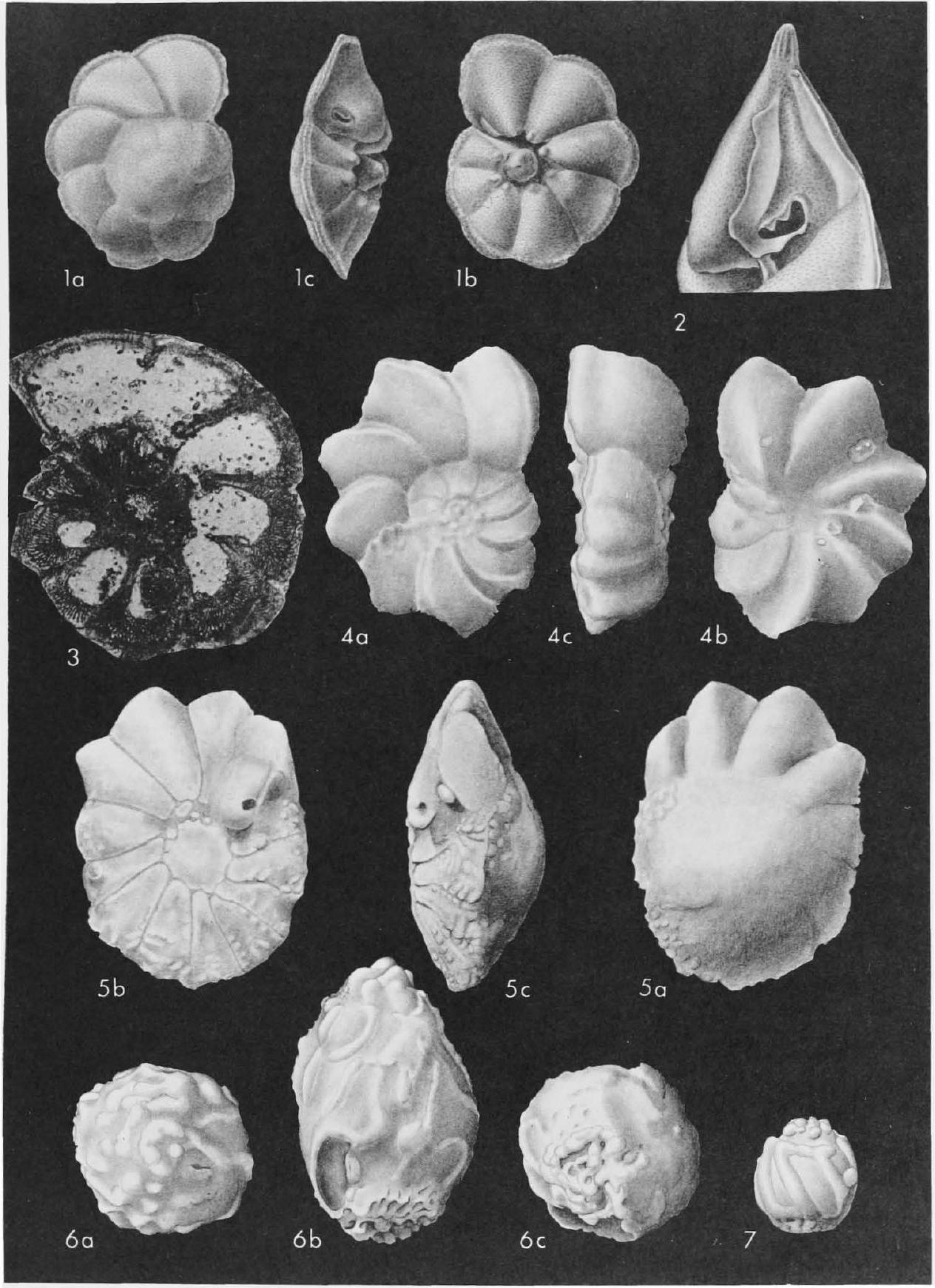 Fig. 487,1-5. *P. schroeteriana (CARPENTER, P ARKER & JONES), Rec., Borneo (1-3,5), ?loc. (4); 1, horiz. sec. showing bifurcating sutural canals, X55; 2, vert. sec. showing tooth plates, umbilical lips and cavities, and sutural canals, X55; 3, horiz. sec. showing tooth plates and relationship to septal flap, X55; 4, oblique ext. view, enlarged; 5, diagram of dissected chamber showing intercameral foramen in septal face, tooth plate attaching below it and labial aperture at umbilical end of chamber (1-3,5, °1534; 4, °281)
Synonyms
Geographic Distribution
E. Indies (Indon.- Borneo).
Age Range
Beginning Stage in Treatise Usage:
Plio.
Beginning International Stage:
Zanclean
Fraction Up In Beginning Stage:
0
Beginning Date:
5.34
Ending Stage in Treatise Usage:
Rec.
Ending International Stage:
Meghalayan
Fraction Up In Ending Stage:
100
Ending Date:
0
Description
Test trochospiral, periphery acute, with imperforate keel chambers with imperforate umbilical lips confined to radial sector and with imperforate plate-like extensions formed by each succeeding chamber lamella covering umbilical area, those added by successive chambers with intervening cavities, imperforate plates may be pierced by few scattered large rounded openings, surrounded by thickened rims but without pillars or buttresses, opening of successive plates not aligned; septa secondarily doubled by septal flaps, which leave intraseptal passages that open to au tside by means of double row of canals in alternating arrangement and sutural position, on both sides of test; wall lamellar, of radially fibrous calcite, coarsely perforate; cameral aperture interiomarginal on umbilical side, partly covered by narrow extension of apertural face, which is resorbed when new chambers are added and aperture becomes intercameral foramen, strongly developed and twisted tooth plate attached at angle, extending backward to close lower part of preceding intercameral foramen, apertural lip forming interiomarginal labial aperture at inner umbilical side of chamber, those of successive chambers remaining open. [Pseudorotalia differs from Rotalia, Ammonia, and Lockhartia in having sutural canals on both spiral and umbilical sides and in lacking umbilical labial apertures.]
References
Reiss, Zeev, , \& Merling, P., 1958, Structure of some Rotaliidea: Israel Geol. Survey, Bull. 21, p. 1-19, pl. 1-5.
Museum or Author Information
Classification
Phylum:
Protista
Subphylum:
Sarcodina
Class:
Reticularea
Subclass:
Granuloreticulosia
Order:
Foraminiferida
Suborder:
Rotalina
Superfamily:
Rotaliacea
Family:
Rotaliidae
Subfamily:
Rotaliinae
Formal Genus Name and Reference:
Pseudorotalia Reiss & Merling, 1958, *1534, p. 13
Type Species:
Rotalia schroeteriana Carpenter, Parker & JONES, 1862, *281, p. 212, OD
Images
(Click to enlarge in a new window)
Fig. 487,1-5. *P. schroeteriana (CARPENTER, P ARKER & JONES), Rec., Borneo (1-3,5), ?loc. (4); 1, horiz. sec. showing bifurcating sutural canals, X55; 2, vert. sec. showing tooth plates, umbilical lips and cavities, and sutural canals, X55; 3, horiz. sec. showing tooth plates and relationship to septal flap, X55; 4, oblique ext. view, enlarged; 5, diagram of dissected chamber showing intercameral foramen in septal face, tooth plate attaching below it and labial aperture at umbilical end of chamber (1-3,5, °1534; 4, °281)
Synonyms
Geographic Distribution
E. Indies (Indon.- Borneo).
Age Range
Beginning Stage in Treatise Usage:
Plio.
Beginning International Stage:
Zanclean
Fraction Up In Beginning Stage:
0
Beginning Date:
5.34
Ending Stage in Treatise Usage:
Rec.
Ending International Stage:
Meghalayan
Fraction Up In Ending Stage:
100
Ending Date:
0
Description
Test trochospiral, periphery acute, with imperforate keel chambers with imperforate umbilical lips confined to radial sector and with imperforate plate-like extensions formed by each succeeding chamber lamella covering umbilical area, those added by successive chambers with intervening cavities, imperforate plates may be pierced by few scattered large rounded openings, surrounded by thickened rims but without pillars or buttresses, opening of successive plates not aligned; septa secondarily doubled by septal flaps, which leave intraseptal passages that open to au tside by means of double row of canals in alternating arrangement and sutural position, on both sides of test; wall lamellar, of radially fibrous calcite, coarsely perforate; cameral aperture interiomarginal on umbilical side, partly covered by narrow extension of apertural face, which is resorbed when new chambers are added and aperture becomes intercameral foramen, strongly developed and twisted tooth plate attached at angle, extending backward to close lower part of preceding intercameral foramen, apertural lip forming interiomarginal labial aperture at inner umbilical side of chamber, those of successive chambers remaining open. [Pseudorotalia differs from Rotalia, Ammonia, and Lockhartia in having sutural canals on both spiral and umbilical sides and in lacking umbilical labial apertures.]
References
Reiss, Zeev, , \& Merling, P., 1958, Structure of some Rotaliidea: Israel Geol. Survey, Bull. 21, p. 1-19, pl. 1-5.