
Welcome to the Forams subsite on Invertebrate Paleontology!
Please enter a genera name to retrieve more information.

Pyrgo
Classification
Phylum:
Protista
Subphylum:
Sarcodina
Class:
Reticularea
Subclass:
Granuloreticulosia
Order:
Foraminiferida
Suborder:
Miliolina
Superfamily:
Miliolacea
Family:
Miliolidae
Subfamily:
Quinqueloculininae
Formal Genus Name and Reference:
Pyrgo DEFRANCE, 1824, *597e, p. 273
Type Species:
P. laevis, od (M)
Images
(Click to enlarge in a new window)
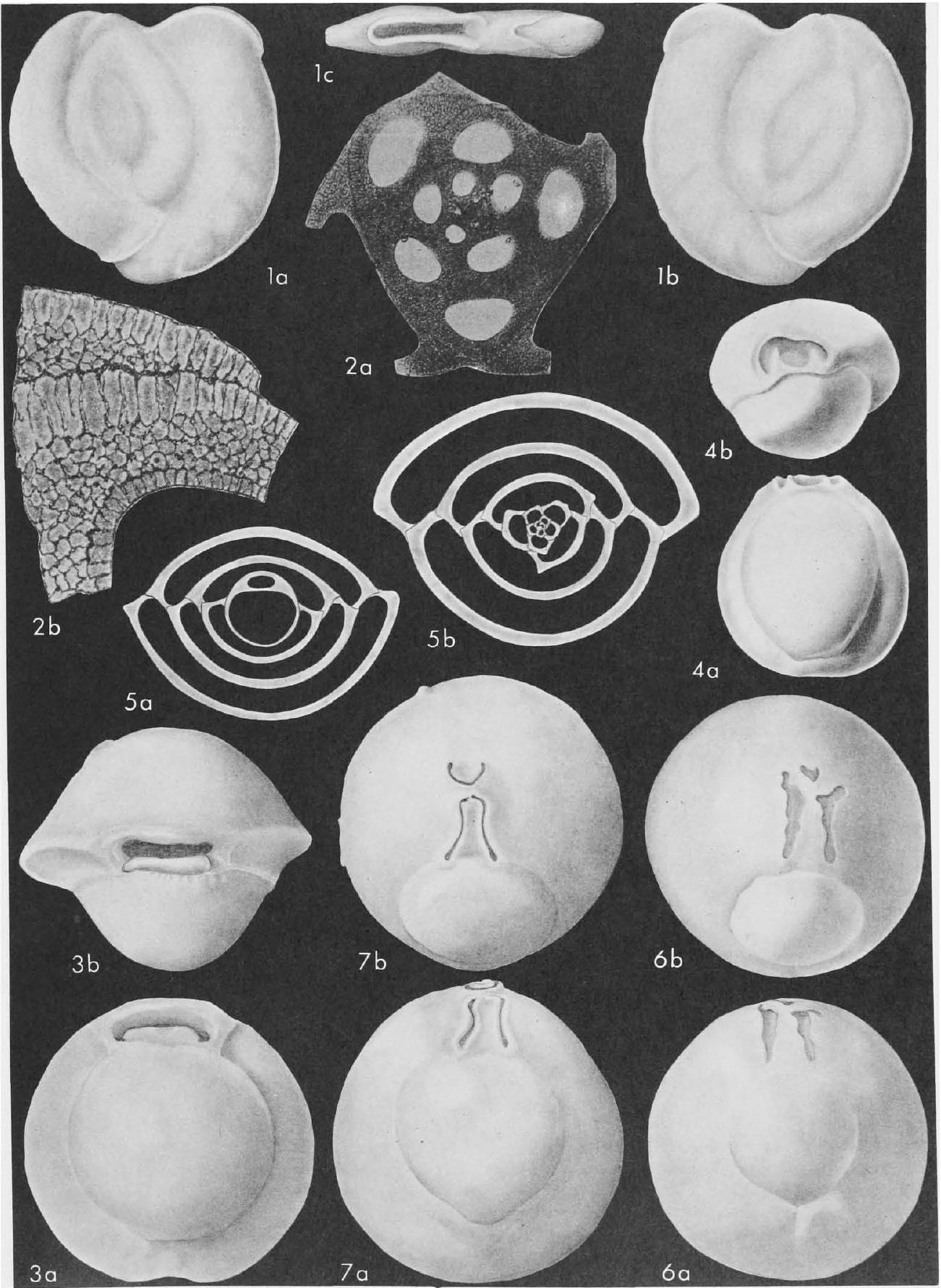
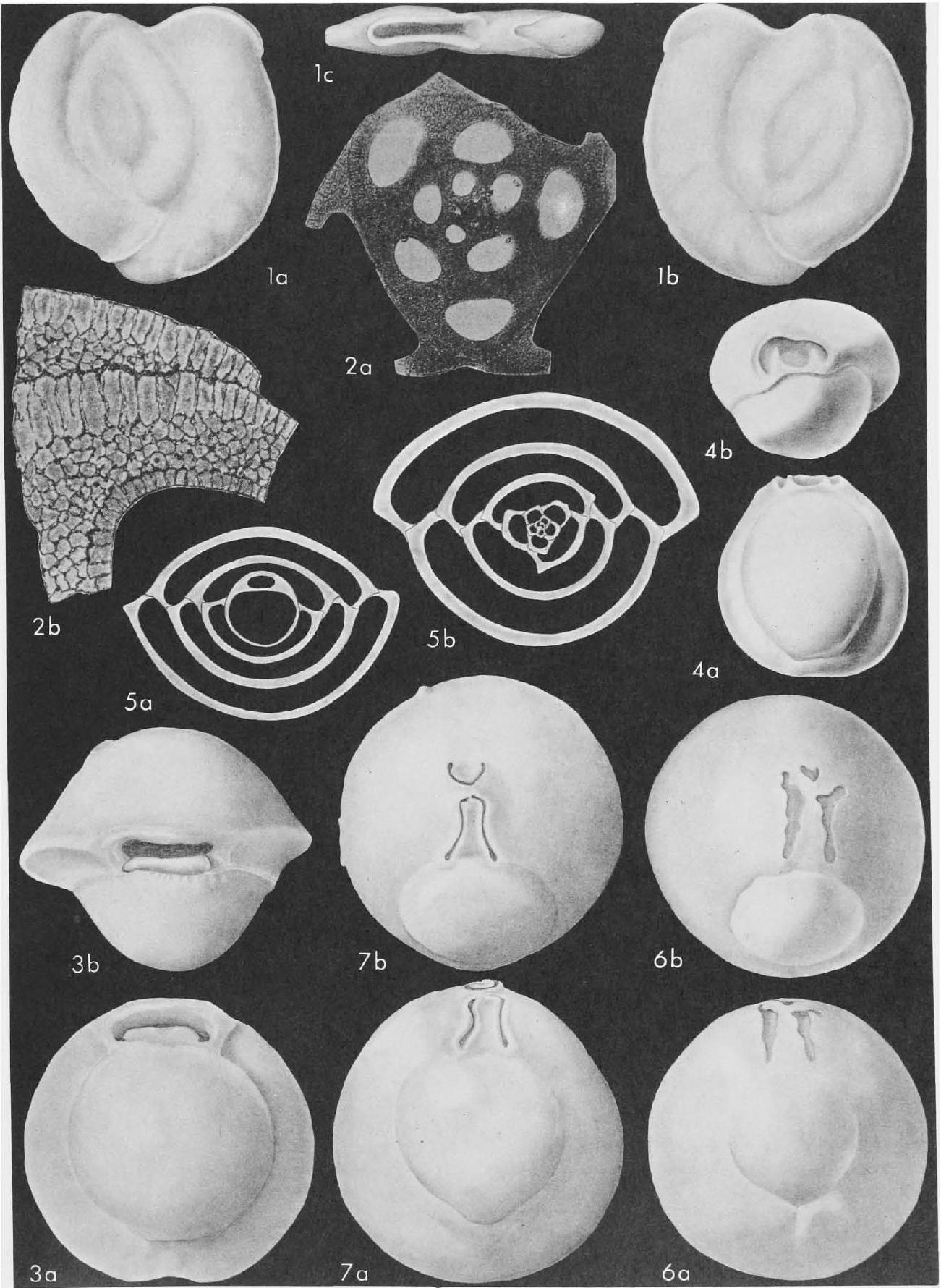
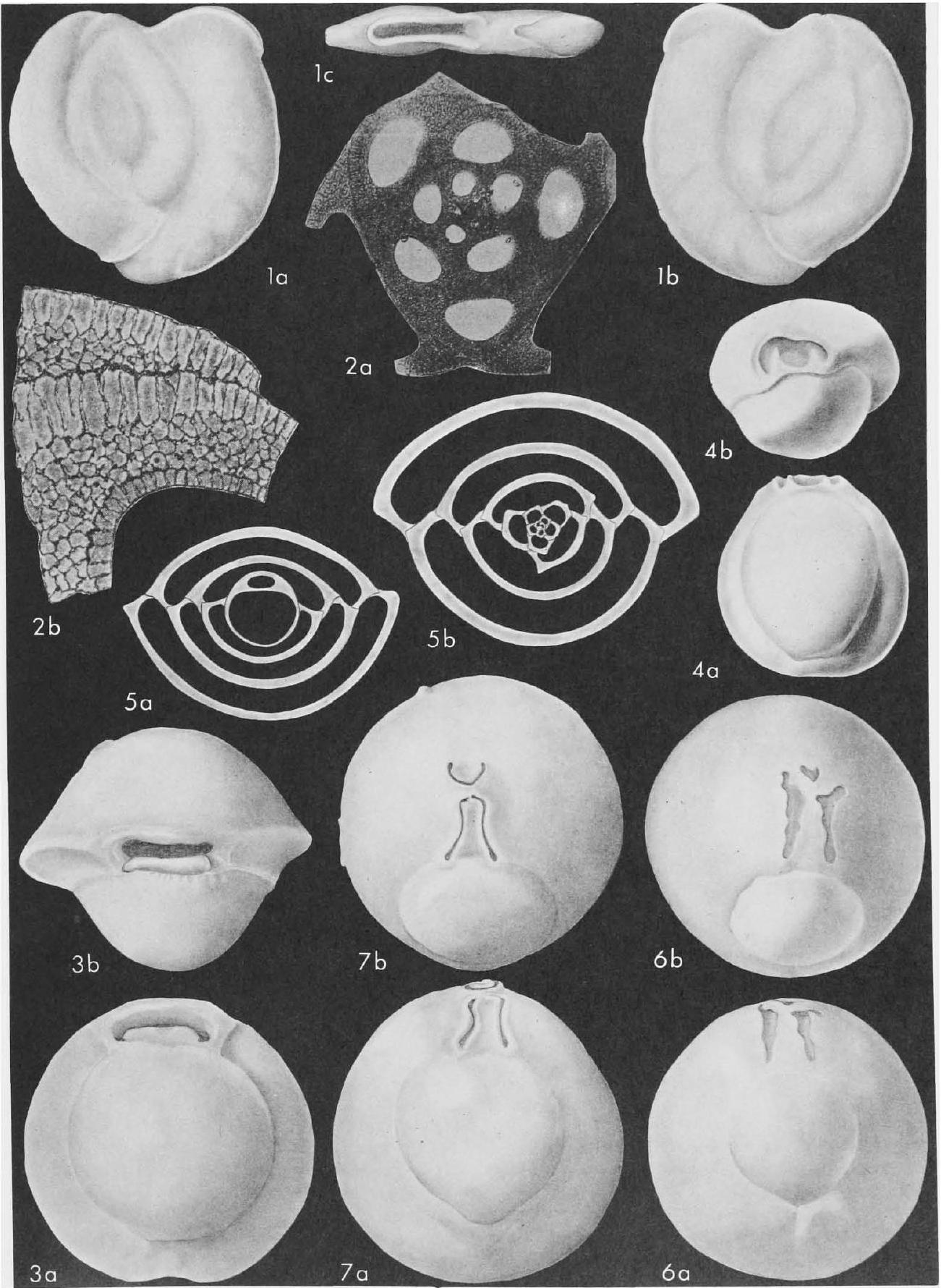 Fig. 352,3. * P. laevis, Plio.(Piacenz.), Eu.(Italy), 3a,b side and apert. views showing relatively broad tooth of this species, X38 (*2117). --Fig. 352,4. *P. williamsoni (Silvestri), Rec., N.Am.(Alaska), 4a,b side and apert. views of species with distinctly bifid tooth, X33 (*1162). --Fig. 352,5. P. sarsi (Schlumberger), Rec., Eu.(N.Sea), 5a,b, secs. of megalospheric and microspheric forms showing chamber arrangement, X20 (*1654).
Synonyms
Biloculina
Geographic Distribution
cosmop.
Age Range
Beginning Stage in Treatise Usage:
Jur.
Beginning International Stage:
Hettangian
Fraction Up In Beginning Stage:
0
Beginning Date:
201.36
Ending Stage in Treatise Usage:
Rec.
Ending International Stage:
Meghalayan
Fraction Up In Ending Stage:
100
Ending Date:
0
Description
Test free, inflated, discoidal to ovate, proloculus followed by chambers one-half coil in length, in microspheric form early chambers arranged in quinqueloculine pattern, later triloculine, and finally biloculine, megalospheric forms may be biloculine throughout development, with successive discoidal to hemispherical chambers opposing each other, wall calcareous, imperforate, porcelaneous, aperture terminal, near junction of 2 last chambers, rounded to elongate, with distinct and commonly bifid tooth. [Pyrgo differs from Biloculinella in having a bifid tooth instead of a broad apertural flap nearly filling the aperture. No locality or horizon was given in the original description of Pyrgo laevis.]
References
Museum or Author Information
Classification
Phylum:
Protista
Subphylum:
Sarcodina
Class:
Reticularea
Subclass:
Granuloreticulosia
Order:
Foraminiferida
Suborder:
Miliolina
Superfamily:
Miliolacea
Family:
Miliolidae
Subfamily:
Quinqueloculininae
Formal Genus Name and Reference:
Pyrgo DEFRANCE, 1824, *597e, p. 273
Type Species:
P. laevis, od (M)
Images
(Click to enlarge in a new window)
Fig. 352,3. * P. laevis, Plio.(Piacenz.), Eu.(Italy), 3a,b side and apert. views showing relatively broad tooth of this species, X38 (*2117). --Fig. 352,4. *P. williamsoni (Silvestri), Rec., N.Am.(Alaska), 4a,b side and apert. views of species with distinctly bifid tooth, X33 (*1162). --Fig. 352,5. P. sarsi (Schlumberger), Rec., Eu.(N.Sea), 5a,b, secs. of megalospheric and microspheric forms showing chamber arrangement, X20 (*1654).
Synonyms
Biloculina
Geographic Distribution
cosmop.
Age Range
Beginning Stage in Treatise Usage:
Jur.
Beginning International Stage:
Hettangian
Fraction Up In Beginning Stage:
0
Beginning Date:
201.36
Ending Stage in Treatise Usage:
Rec.
Ending International Stage:
Meghalayan
Fraction Up In Ending Stage:
100
Ending Date:
0
Description
Test free, inflated, discoidal to ovate, proloculus followed by chambers one-half coil in length, in microspheric form early chambers arranged in quinqueloculine pattern, later triloculine, and finally biloculine, megalospheric forms may be biloculine throughout development, with successive discoidal to hemispherical chambers opposing each other, wall calcareous, imperforate, porcelaneous, aperture terminal, near junction of 2 last chambers, rounded to elongate, with distinct and commonly bifid tooth. [Pyrgo differs from Biloculinella in having a bifid tooth instead of a broad apertural flap nearly filling the aperture. No locality or horizon was given in the original description of Pyrgo laevis.]