
Welcome to the Forams subsite on Invertebrate Paleontology!
Please enter a genera name to retrieve more information.

Tournayella
Classification
Phylum:
Protista
Subphylum:
Sarcodina
Class:
Reticularea
Subclass:
Granuloreticulosia
Order:
Foraminiferida
Suborder:
Fusulinina
Superfamily:
Endothyracea
Family:
Tournayellidae
Formal Genus Name and Reference:
Tournayella Dain in Dain & GROZDILOVA, 1953, *550, p. 30
Type Species:
T. discoidea, OD
Images
(Click to enlarge in a new window)
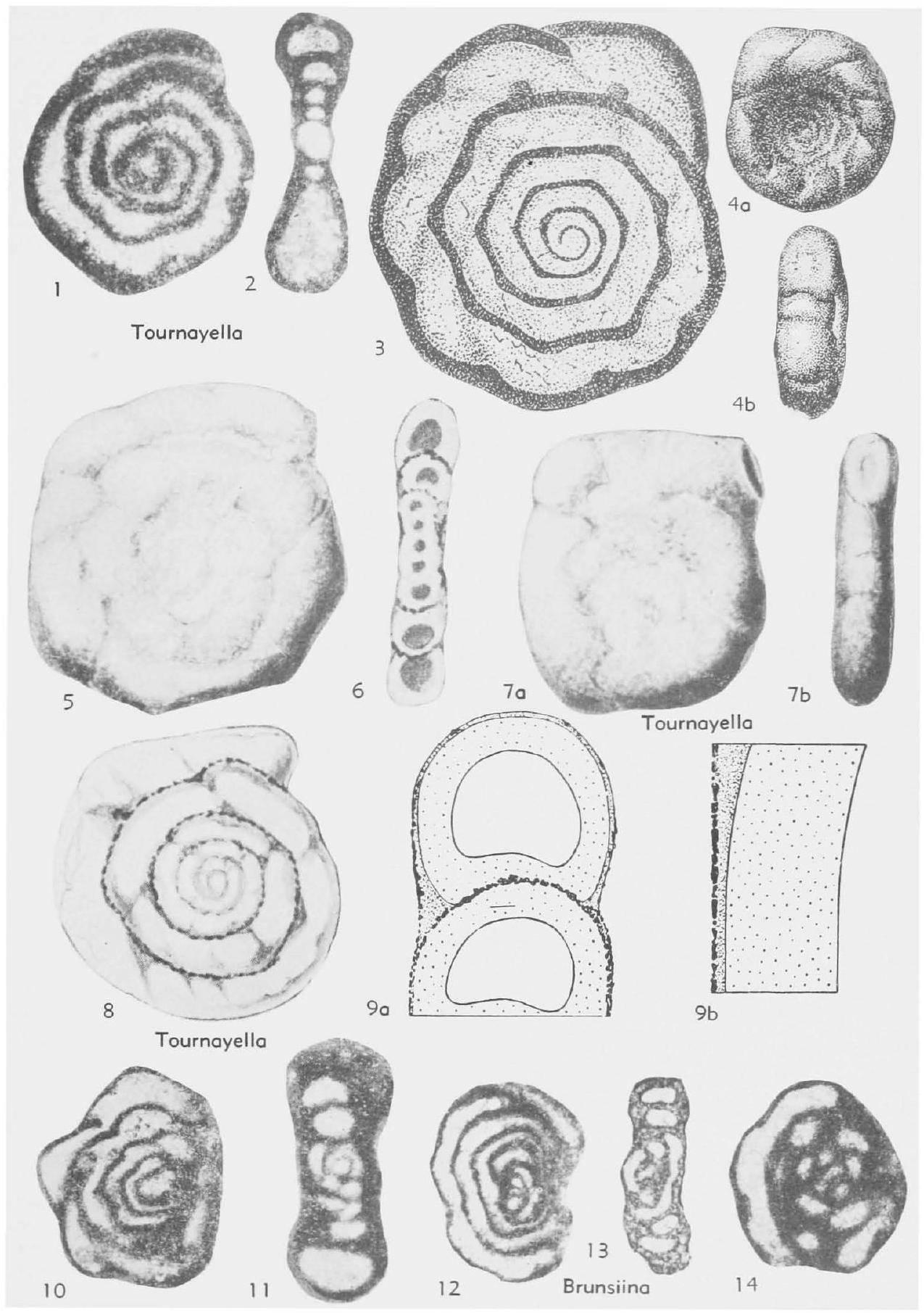
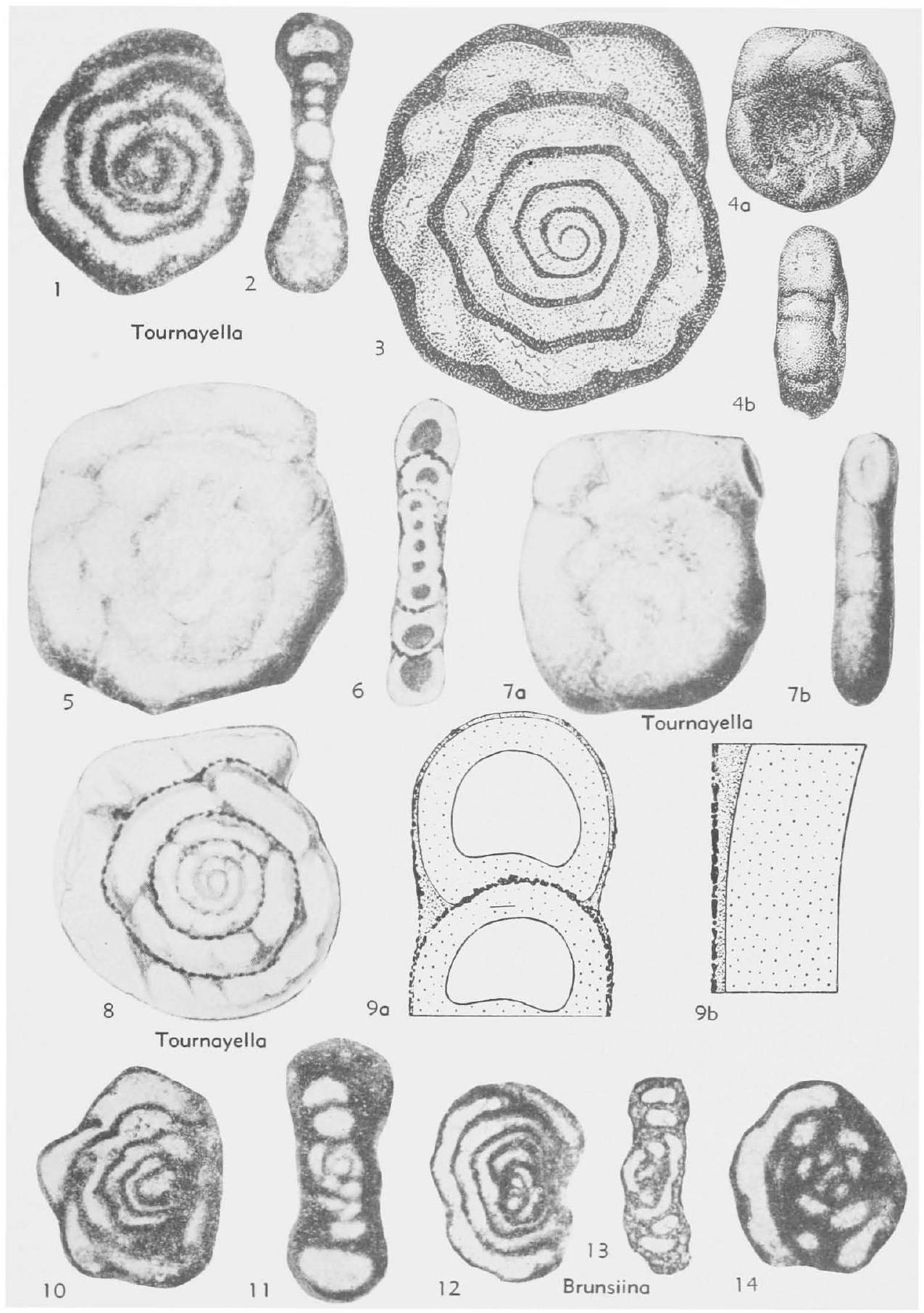 Fig. 257,1,2. *T. discoidea, Tournais., USSR(Donets Basin); 1, equat. sec. of holotype; 2, axial sec. of paratype; both X100 (*550). --Fig.257,3,4. T.spectabilis (DAIN), Tournais., USSR(Donets Basin); 3, equat.
sec., X60 (*550); 4a,b, side, edge views of holotype, X43 (*550). --Fig. 257,5-9. T. cepeki (VAsIcEK & RUZICKA), Namur., Czech.; 5,7a.b, side, edge views of paratypes; 6,8, axial and equal. sees. of paratypes, X81; 9a,b, diagrams of wall structure showing part of axial sec. and enlargement of one side of wall with inner granular layer regarded as equivalent to epitheca of fusulinids, dark thin opaque layer resembling fusulinid tectum, and secondary thickening at septal depressions (=protheca) (*1985). --Fig. 257, 10. 11. T. segmentata DAIN, Tournais., USSR; 10, equat. sec., X70 (*1143); 11. axial sec., X81
(*831).
Fig. 257,1,2. *T. discoidea, Tournais., USSR(Donets Basin); 1, equat. sec. of holotype; 2, axial sec. of paratype; both X100 (*550). --Fig.257,3,4. T.spectabilis (DAIN), Tournais., USSR(Donets Basin); 3, equat.
sec., X60 (*550); 4a,b, side, edge views of holotype, X43 (*550). --Fig. 257,5-9. T. cepeki (VAsIcEK & RUZICKA), Namur., Czech.; 5,7a.b, side, edge views of paratypes; 6,8, axial and equal. sees. of paratypes, X81; 9a,b, diagrams of wall structure showing part of axial sec. and enlargement of one side of wall with inner granular layer regarded as equivalent to epitheca of fusulinids, dark thin opaque layer resembling fusulinid tectum, and secondary thickening at septal depressions (=protheca) (*1985). --Fig. 257, 10. 11. T. segmentata DAIN, Tournais., USSR; 10, equat. sec., X70 (*1143); 11. axial sec., X81
(*831).
Synonyms
Carbonella
Geographic Distribution
USSR-Czech.
Age Range
Beginning Stage in Treatise Usage:
U.Dev.
Beginning International Stage:
Frasnian
Fraction Up In Beginning Stage:
0
Beginning Date:
378.9
Ending Stage in Treatise Usage:
U. Carb. (Namur.)
Ending International Stage:
Bashkirian
Fraction Up In Ending Stage:
48.4
Ending Date:
319.4
Description
Test discoidal, with spherical proloculus and planispirally coiled pseudoseptate later portion, slight apertural constrictions of tubular chamber being preserved as poorly developed sepIa or slight infoldings of wall; wall thick, calcareous, inner thick translucent layer of micro granular calcite with thin dark opaque layer developed where final whorl overlaps previous coils, and secondary calcareous translucent thickening in sutural depressions; aperture simple rounded or elliptical opening formed by moderate constriction of terminal portion of tubular chambers.
References
Museum or Author Information
Classification
Phylum:
Protista
Subphylum:
Sarcodina
Class:
Reticularea
Subclass:
Granuloreticulosia
Order:
Foraminiferida
Suborder:
Fusulinina
Superfamily:
Endothyracea
Family:
Tournayellidae
Formal Genus Name and Reference:
Tournayella Dain in Dain & GROZDILOVA, 1953, *550, p. 30
Type Species:
T. discoidea, OD
Images
(Click to enlarge in a new window)
Fig. 257,1,2. *T. discoidea, Tournais., USSR(Donets Basin); 1, equat. sec. of holotype; 2, axial sec. of paratype; both X100 (*550). --Fig.257,3,4. T.spectabilis (DAIN), Tournais., USSR(Donets Basin); 3, equat.
sec., X60 (*550); 4a,b, side, edge views of holotype, X43 (*550). --Fig. 257,5-9. T. cepeki (VAsIcEK & RUZICKA), Namur., Czech.; 5,7a.b, side, edge views of paratypes; 6,8, axial and equal. sees. of paratypes, X81; 9a,b, diagrams of wall structure showing part of axial sec. and enlargement of one side of wall with inner granular layer regarded as equivalent to epitheca of fusulinids, dark thin opaque layer resembling fusulinid tectum, and secondary thickening at septal depressions (=protheca) (*1985). --Fig. 257, 10. 11. T. segmentata DAIN, Tournais., USSR; 10, equat. sec., X70 (*1143); 11. axial sec., X81
(*831).
Synonyms
Carbonella
Geographic Distribution
USSR-Czech.
Age Range
Beginning Stage in Treatise Usage:
U.Dev.
Beginning International Stage:
Frasnian
Fraction Up In Beginning Stage:
0
Beginning Date:
378.9
Ending Stage in Treatise Usage:
U. Carb. (Namur.)
Ending International Stage:
Bashkirian
Fraction Up In Ending Stage:
48.4
Ending Date:
319.4
Description
Test discoidal, with spherical proloculus and planispirally coiled pseudoseptate later portion, slight apertural constrictions of tubular chamber being preserved as poorly developed sepIa or slight infoldings of wall; wall thick, calcareous, inner thick translucent layer of micro granular calcite with thin dark opaque layer developed where final whorl overlaps previous coils, and secondary calcareous translucent thickening in sutural depressions; aperture simple rounded or elliptical opening formed by moderate constriction of terminal portion of tubular chambers.